
Fitness trackers and smartwatches now do far more than count steps. They track heart rate, sleep, workouts and blood oxygen, and some take an ECG. With so many models, it is easy to pay for features you will never use or miss the one you needed. This guide helps you decide between a fitness band and a smartwatch, explains which health features are reliable, and gives you a checklist to compare models before you buy.
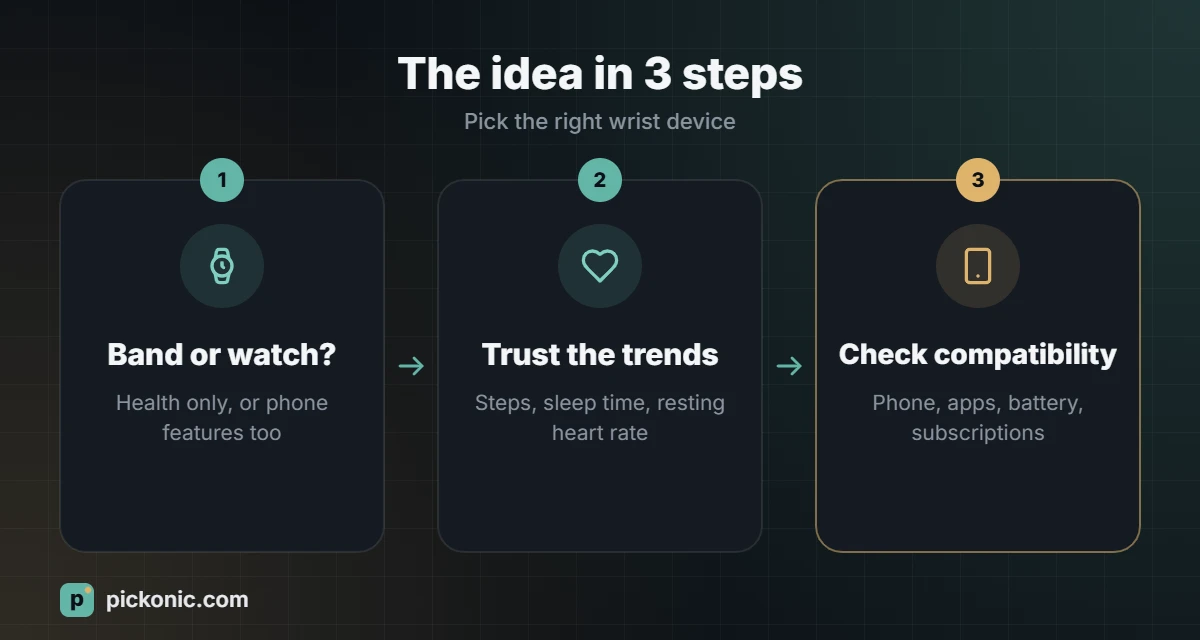
Fitness band or smartwatch?
| Fitness band | Smartwatch | |
|---|---|---|
| Main focus | Activity, sleep and heart-rate tracking | Phone features plus health tracking |
| Battery life | Often around a week or more | From about a day to a couple of weeks, depending on the model |
| Screen | Small and simple | Larger, brighter, with apps |
| Comfort at night | Light and easy to sleep in | Bulkier; some people take them off at night |
| Price | Lower | Medium to high |
If your goal is to move more and sleep better, a band is often enough. If you also want notifications, calls, payments, maps and apps on your wrist, a smartwatch makes sense.
Health features: what is reliable?
- Steps and distance: generally good for trends. Distance is more accurate on models with built-in GPS.
- Heart rate: optical wrist sensors are good at rest and during steady exercise like walking or running. They can lag during fast interval training or weightlifting. For serious training, a chest strap is more accurate.
- Sleep tracking: good at measuring how long you sleep and how consistent your schedule is. The split into light, deep and REM sleep is an estimate.
- Blood oxygen (SpO2): useful as a general wellness indicator, not a medical measurement.
- ECG and irregular rhythm alerts: some watches have features cleared by health regulators in certain countries to detect signs of atrial fibrillation. They can prompt you to see a doctor but do not diagnose.
- Calories burned: the least accurate number on most devices. Treat it as a rough guide.
Checklist before you buy
- Phone compatibility. Some watches work only with iPhone, others work best with Android or with one brand of phone. Check this first.
- Battery life in real use. Advertised battery life often assumes features like GPS and always-on display are off. Read reviews for real-world numbers.
- Built-in GPS. Essential if you run or cycle without your phone.
- Water resistance. Look for a rating suitable for swimming if you swim.
- Comfort and size. You will wear it most of the day and night. Check the case size and weight.
- Display readability. An AMOLED screen looks great; check it is readable in strong sunlight.
- App and data. Does the companion app show trends clearly? Can you export data or sync with Apple Health, Google Health Connect or Strava?
- Subscriptions. Some brands put advanced insights behind a monthly subscription. Count that in the total cost.
- Contactless payments. Check that your bank supports the watch’s payment service in your country.
- Arabic support. If you need Arabic notifications to display correctly, check the language support for the model.
Which type suits you?
| You are… | Look at |
|---|---|
| Starting to walk more and sleep better | A simple fitness band with good sleep tracking and long battery |
| An iPhone user who wants an all-rounder | Apple Watch range |
| An Android user who wants an all-rounder | Samsung Galaxy Watch or Google Pixel Watch, depending on your phone |
| A runner, cyclist or hiker | A sports watch from brands like Garmin, Coros, Polar or Suunto with strong GPS and battery |
| Focused on recovery and training load | Devices built around recovery scores, some of which use a subscription model |
Making the data useful
A tracker only helps if you act on what it shows. A few habits make the difference:
- Set a realistic daily goal. If you average 4,000 steps, aim for 6,000 before jumping to 10,000.
- Watch your resting heart rate over weeks. A gradual decline often reflects improving fitness; a sudden rise can be a sign of stress, poor sleep or illness.
- Use sleep data to fix your schedule. Going to bed at a consistent time often matters more than any single night’s score.
- Combine it with other measurements: a smart scale for weight trends and our BMI calculator for a quick health check.
Frequently asked questions
How accurate are step counts?
Most wrist devices are accurate enough for daily trends, but they can count arm movements as steps or miss steps when you push a trolley. Compare day to day with the same device.
Can a smartwatch replace a medical device?
No. Health features are designed for wellness and early warnings. If you have symptoms or a known condition, follow your doctor’s advice and use approved medical devices.
Should I buy last year’s model?
Often yes. When a new model launches, the previous generation usually drops in price and still gets software updates for a while. Check how long the brand supports older models.
This article is for general information and is not medical advice.