
A regular bathroom scale tells you one number. A smart scale promises a dozen: body fat, muscle mass, water, bone mass, visceral fat, “metabolic age”. Some of these are useful, some are rough estimates, and knowing which is which is the key to buying the right scale. This guide explains how smart scales work, what they measure well, and the features worth paying for.
How a smart scale measures body composition
Most smart scales use bioelectrical impedance analysis (BIA). Metal pads on the scale send a very small, harmless electrical current up one leg and down the other. Fat resists the current more than muscle and water do, so the scale measures that resistance and combines it with your height, age and sex to estimate body composition using a formula.
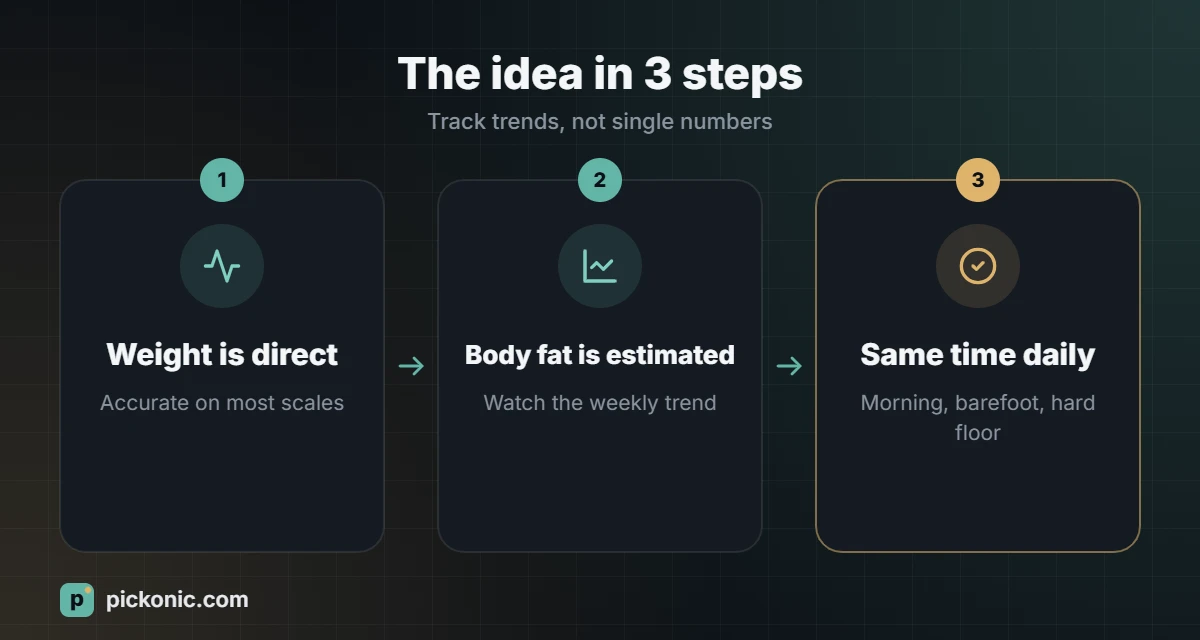
Two things follow from this. First, your weight is measured directly and is usually accurate. Second, everything else is an estimate, and it is sensitive to how hydrated you are, when you last ate or exercised, and even the temperature of your feet.
Accuracy vs consistency
Independent studies generally find that home BIA scales can be several percentage points away from lab methods for body fat. That sounds bad, but what matters at home is consistency. If the scale reads 24% today and 22% in three months under the same conditions, the downward trend is real even if the exact number is not. Use a smart scale to watch direction, not to chase a precise figure.
How to get consistent readings
- Weigh yourself at the same time, ideally in the morning after using the bathroom and before eating or drinking.
- Stand barefoot with dry feet, centred on the electrodes.
- Avoid measuring right after exercise, a sauna or a large meal.
- Place the scale on a hard, flat floor, not on a rug.
- Look at weekly averages instead of daily swings.
What the numbers mean
| Metric | How reliable at home | Useful for |
|---|---|---|
| Weight | High | Daily and weekly tracking |
| BMI | High (simple calculation from weight and height) | A quick screening number |
| Body fat % | Moderate; estimate | Trends over weeks and months |
| Muscle mass | Moderate; estimate | Spotting muscle loss when dieting |
| Body water % | Varies a lot daily | Mostly context for other readings |
| Visceral fat, bone mass, metabolic age | Low to moderate; formula-based | Rough indicators only |
You can check the BMI your scale reports against our BMI calculator, which also shows the healthy weight range for your height.
Features worth paying for
- Good app and syncing. The scale is only as useful as its app. Check that it syncs with the platform you already use, such as Apple Health, Google Health Connect, Samsung Health, Garmin Connect or Fitbit, so all your data lives in one place.
- Wi-Fi as well as Bluetooth. Bluetooth-only scales need your phone nearby to sync. Wi-Fi models upload readings on their own.
- Automatic user recognition. If several family members share the scale, it should recognise who is standing on it and keep profiles separate.
- Athlete mode. Standard BIA formulas tend to overestimate body fat in very muscular people. An athlete mode adjusts for this.
- Hand electrodes (8-electrode scales). Foot-only scales mostly measure the lower body. Models with a handle measure the upper body too and can give per-limb estimates. They cost more.
- Readable display. A clear screen that shows trend arrows is handy if you do not want to open the app every time.
- Battery type. Rechargeable or standard AAA batteries both work; just check which one you prefer.
Choosing by budget
| Level | What you typically get | Good for |
|---|---|---|
| Entry | Bluetooth, 4 electrodes, basic app, weight and body fat estimate | Trying weight tracking for the first time |
| Mid-range | Wi-Fi, multi-user recognition, better app, health platform sync | Families and long-term tracking |
| Premium | 8 electrodes, per-limb analysis, extra metrics like heart rate, polished app | Fitness enthusiasts and detailed tracking |
Well-known brands in this category include Withings, Garmin, Eufy, Renpho and Xiaomi. Compare the current models on the features above rather than on the number of metrics listed on the box.
Who should not use body-fat measurement
Manufacturers advise people with a pacemaker or other implanted electronic medical device not to use the body composition (BIA) function. Many also advise against it during pregnancy. Most scales let you turn off the electrical measurement and use weight only. If you have a heart condition or any medical device, check with your doctor first.
Frequently asked questions
Why does my body fat change so much from day to day?
Mostly because of hydration. Drinking a lot of water, sweating or eating salty food changes the electrical reading. Watch the weekly average instead.
Is a smart scale worth it if I only care about weight?
A smart scale still helps because it records every reading automatically and shows trends. If you prefer not to share data with an app, a good basic scale and a notebook do the job.
Can two scales give different body fat numbers?
Yes. Each brand uses its own formula. Pick one scale and stick with it so your trend stays comparable.
This article is for general information and is not medical advice.