
Your semester GPA tells you how this term went. Your cumulative GPA is the number on your transcript, the one employers and graduate schools look at. Working it out yourself is simple once you stop averaging GPAs and start averaging points.
Why you cannot just average your GPAs
Suppose you had a 3.8 in a light 12-credit semester and a 3.0 in a heavy 18-credit semester. The simple average is 3.4, but that treats both terms as equally important. The heavier term contains more credits, so it should count for more. The correct cumulative GPA is (3.8 × 12 + 3.0 × 18) ÷ 30 = 3.32.
The method
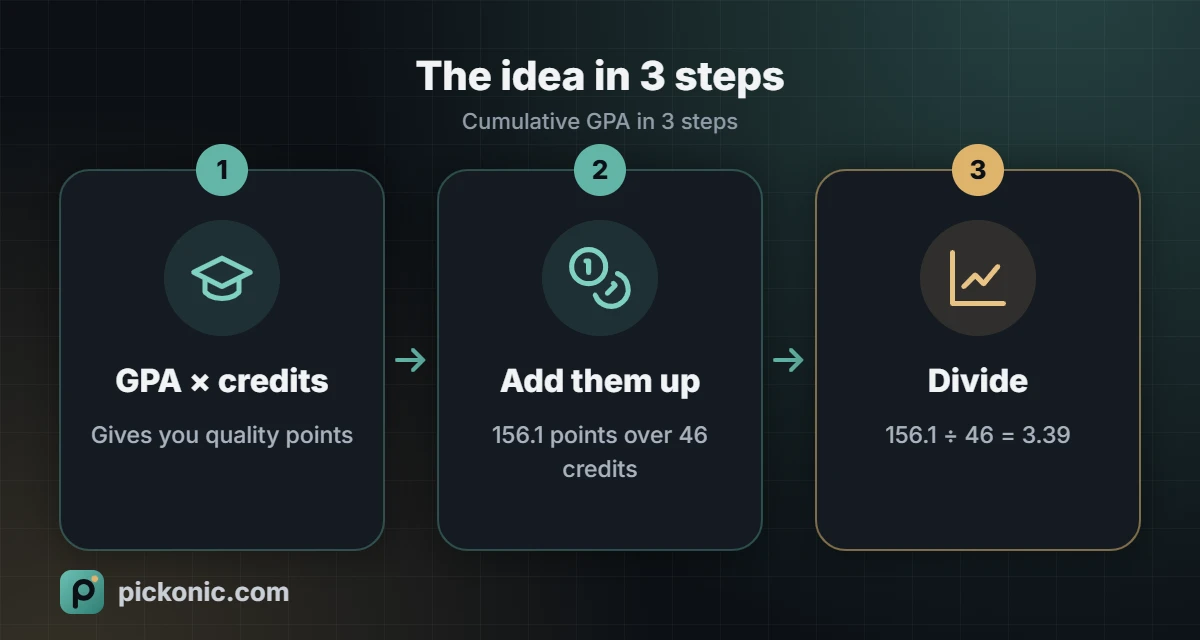
- For each semester, multiply its GPA by its credit hours. That gives you quality points.
- Add up all the quality points.
- Add up all the credit hours.
- Divide total points by total credits.
A full example
| Semester | GPA | Credits | Quality points |
|---|---|---|---|
| Fall year 1 | 3.40 | 15 | 51.0 |
| Spring year 1 | 3.10 | 16 | 49.6 |
| Fall year 2 | 3.70 | 15 | 55.5 |
| Total | 46 | 156.1 |
Cumulative GPA = 156.1 ÷ 46 = 3.39.
Planning for a target
Want to reach 3.5 by the end of next semester with 15 more credits? You need a total of 3.5 × 61 = 213.5 quality points. You already have 156.1, so next semester must bring 57.4 points, which means a semester GPA of 57.4 ÷ 15 = 3.83. That is ambitious but possible, and knowing the exact number helps you decide where to focus.
Things that can change the result
- Pass/fail courses usually count toward credits earned but not toward GPA.
- Retakes: some universities replace the old grade, others keep both.
- Transfer credits often appear on your transcript without affecting your GPA.
When in doubt, follow your university’s official regulations.
Raising your cumulative GPA: how much is possible?
Because the cumulative GPA is weighted by credits, every new semester has less pull than the last. Suppose you have a 2.9 GPA after 60 credits and want to reach 3.2. You currently have 2.9 × 60 = 174 grade points. If you take 15 credits next semester, you need 3.2 × 75 = 240 points in total, so 66 points from 15 credits. That is a semester GPA of 4.4, which is impossible on a 4.0 scale.
Over two semesters (30 credits), you would need 3.2 × 90 = 288 points, so 114 points from 30 credits, a semester GPA of 3.8. Hard, but possible. This is why it pays to do the arithmetic before setting a target: it tells you whether you need one strong semester or a year of consistent work.
A table of how much one semester can move your GPA
Starting from a 3.0 cumulative GPA and taking 15 credits:
| Credits completed so far | Semester GPA of 4.0 | Semester GPA of 3.5 |
|---|---|---|
| 30 | 3.33 | 3.17 |
| 60 | 3.20 | 3.10 |
| 90 | 3.14 | 3.07 |
The earlier you improve, the more it shows. A strong second year moves your GPA far more than a strong final year.
Repeated courses, pass/fail and transfer credits
- Repeated courses: some universities replace the old grade with the new one, others average both or count both attempts. This can change your GPA a lot, so check your university’s policy before retaking a course.
- Pass/fail courses: they usually count toward credits needed to graduate but not toward GPA.
- Transfer credits: credits from another institution are often accepted without the grade, so they do not affect your GPA at the new university.
- Withdrawals: a “W” normally does not enter the GPA, but too many can raise questions on a transcript.
Once you have your number, our guide on what counts as a good GPA shows how it compares on the 4.0 and 5.0 scales.
Frequently asked questions
Is cumulative GPA the same as overall GPA?
Yes, the terms are used interchangeably. Both mean the GPA across all semesters, weighted by credits.
Do failed courses count in cumulative GPA?
Usually yes, an F counts as zero points for its credits. Some universities remove it from the GPA after a successful retake.
How do I convert a percentage to GPA?
There is no universal formula. Universities and scholarship bodies publish their own conversion tables, so use the one from the institution that will read your transcript.
What GPA do employers look for?
Many graduate programmes and some employers use 3.0 out of 4.0 as a rough cut-off, but experience, projects and interviews usually matter more once you are past the first screen.