
Percentage change is one of those things everyone learned at school and few people feel confident about. Did your rent really go up 10%? Is a “30% off” sale as good as it sounds? The method is the same every time, and it takes three steps.
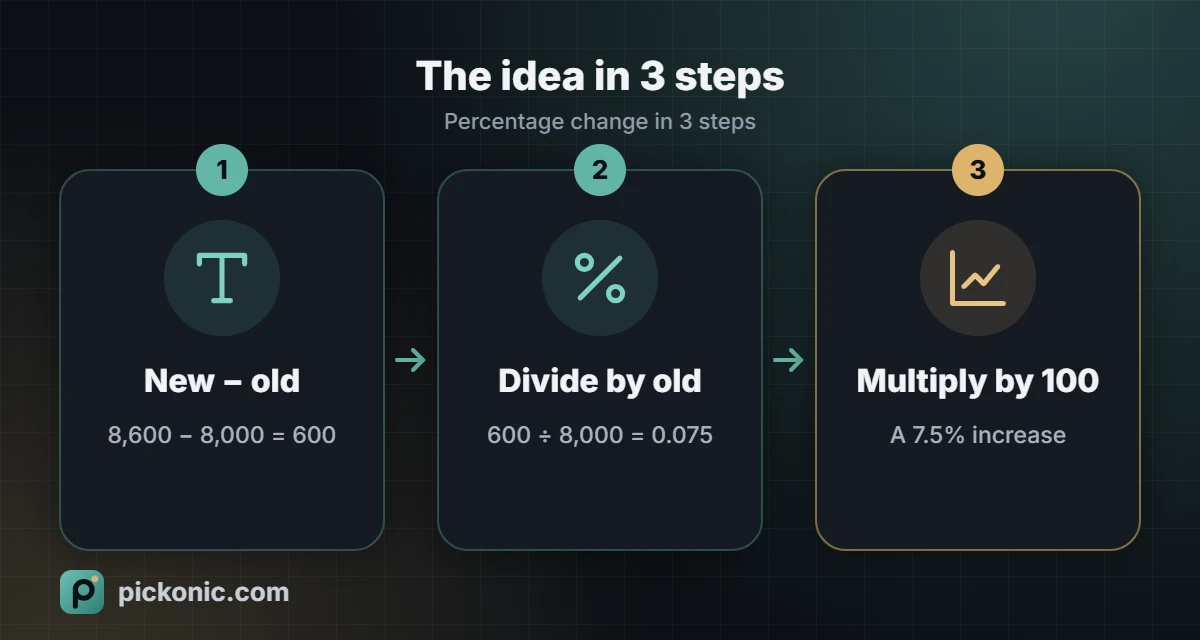
The three steps
- Find the difference: new value minus old value.
- Divide the difference by the old value.
- Multiply by 100.
A positive answer is an increase. A negative answer is a decrease.
Everyday examples
A salary rise
Your salary goes from 8,000 to 8,600. The difference is 600. 600 ÷ 8,000 = 0.075, so that is a 7.5% rise.
A price drop
A phone drops from 3,200 to 2,720. The difference is −480. −480 ÷ 3,200 = −0.15, a 15% decrease.
Rent renewal
Rent rises from 45,000 to 49,500 a year. 4,500 ÷ 45,000 = 0.10, a 10% increase.
Going the other way: applying a percentage
To increase a number by a percentage, multiply by 1 plus the rate. To decrease it, multiply by 1 minus the rate.
decrease by 15%: value × 0.85
The mistake almost everyone makes
Percentages always work on the current value. A 25% fall followed by a 25% rise does not get you back to where you started: 200 falls to 150, and 25% of 150 is only 37.5, so you end at 187.5. This is why a share price that drops 50% needs to rise 100% to recover.
Percent vs percentage points
If an interest rate moves from 4% to 5%, it has risen by one percentage point, but by 25% in relative terms. News headlines often mix the two, so it is worth checking which one is meant.
Percentage change in real decisions
Comparing two job offers
Offer A pays 14,000 a month and Offer B pays 15,200. The difference is 1,200, and 1,200 ÷ 14,000 × 100 = 8.6%. Looked at from the other side, Offer A is 1,200 ÷ 15,200 × 100 = 7.9% lower than Offer B. Both numbers are correct; they just use a different starting point. When you negotiate, be clear about which salary you are measuring from.
Tracking your spending
Your grocery bill went from 1,800 in January to 2,070 in March. That is (2,070 − 1,800) ÷ 1,800 × 100 = 15%. Seeing a monthly bill rise 15% in two months is a much clearer signal than “it went up a bit”, and it tells you exactly how much needs to come out of the budget elsewhere.
Reading a news headline
“Prices fell 20% after rising 25%” sounds like they ended up lower. They did not: 100 rises to 125, and 20% off 125 brings it back to exactly 100. Percentages always depend on the base they are applied to.
Reverse percentages: finding the original value
Sometimes you know the result and the percentage, and need the starting figure. If a jacket costs 280 after a 30% discount, the original price is not 280 + 30%. It is 280 ÷ (1 − 0.30) = 400. In the same way, if your salary is 12,600 after a 5% raise, your old salary was 12,600 ÷ 1.05 = 12,000.
The rule: divide by (1 + the increase) to undo a rise, and by (1 − the decrease) to undo a drop. Adding or subtracting the percentage from the final number gives the wrong answer every time.
Percentage change over several periods
If a value grows 10% one year and 10% the next, the total growth is not 20%. 100 becomes 110, then 121, so the total is 21%. Over longer stretches the gap gets large: 10% a year for seven years almost doubles a number (1.1⁷ ≈ 1.95). This is the same compounding that makes savings grow and debts snowball.
To find the average yearly rate from a start and end value, use: (end ÷ start)^(1 ÷ years) − 1. A rent that went from 50,000 to 60,000 over three years rose by about 6.3% a year on average, not 6.67%.
Frequently asked questions
What is the formula for percentage increase?
(New value − old value) ÷ old value × 100. A positive result is an increase; a negative result is a decrease.
Can a percentage increase be more than 100%?
Yes. Going from 50 to 150 is a 200% increase, because the rise of 100 is twice the original 50.
Why can a decrease never be more than 100%?
Because a value cannot fall below zero. Dropping from 80 to 0 is a 100% decrease, the maximum possible.
How do I calculate percentage change in Excel?
Use =(B1−A1)/A1 and format the cell as a percentage, where A1 is the old value and B1 the new one.