
“Is my GPA good?” sounds like a simple question, but the honest answer is: it depends on the scale, what you want to do next, and how competitive that path is. A 3.4 can be excellent in one place and average in another. Let us untangle it.
Two common scales
Most universities in the United States, and many international programmes, use a 4.0 scale: an A is worth 4 points, a B is 3, a C is 2 and so on, with plus and minus grades in between. Many universities in Saudi Arabia use a 5.0 scale, where an A+ is worth 5 and an A is 4.75.
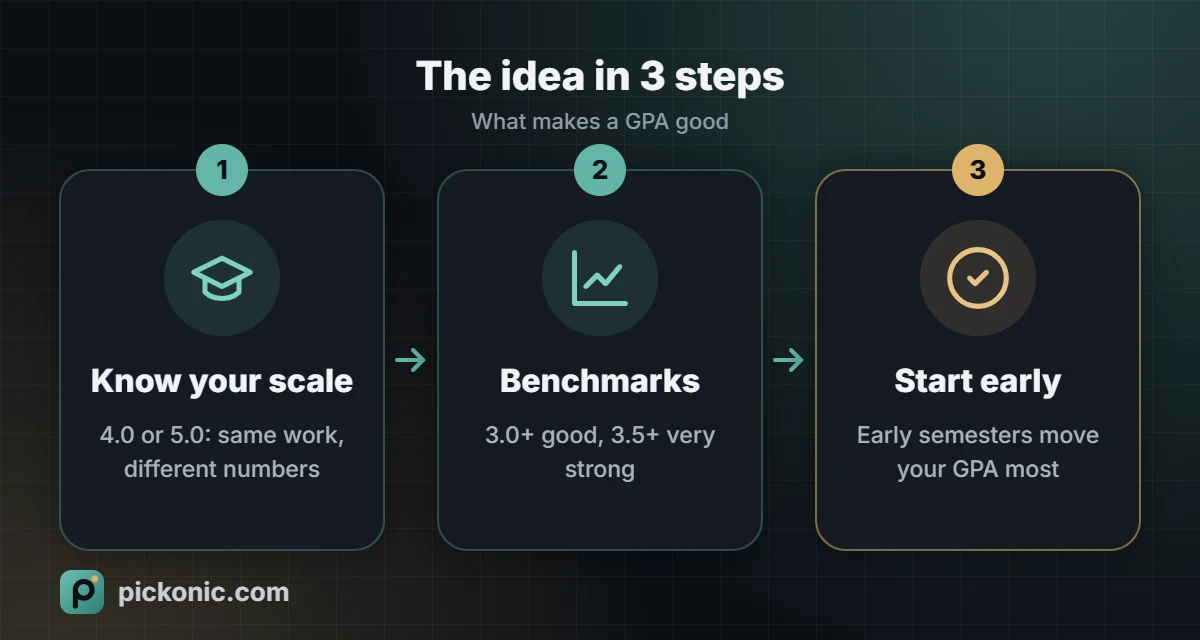
The scale changes how the number looks, not how good the work is. A 4.5 on a 5.0 scale and a 3.6 on a 4.0 scale both describe a student who earns mostly A and B grades.
Rough benchmarks on a 4.0 scale
| GPA | How it is usually seen |
|---|---|
| 3.7 – 4.0 | Outstanding, mostly A grades |
| 3.3 – 3.69 | Very strong |
| 3.0 – 3.29 | Good, a common minimum for graduate programmes and graduate jobs |
| 2.0 – 2.99 | Satisfactory, usually enough to stay in good standing |
| Below 2.0 | Often triggers academic probation |
Typical ratings on a 5.0 scale
| GPA | Rating |
|---|---|
| 4.50 – 5.00 | Excellent |
| 3.75 – 4.49 | Very good |
| 2.75 – 3.74 | Good |
| 2.00 – 2.74 | Pass |
Always check your own university’s regulations. Thresholds for honours, scholarships and probation vary.
“Good” depends on your next step
If you are aiming for a competitive master’s programme or a scholarship, the bar is higher, often 3.5 and above on a 4.0 scale. Many employers screen graduate applications at around 3.0. If you simply want to graduate comfortably, staying above 2.0 is what matters. Decide what you are aiming for, then work backwards.
Why your GPA moves less each year
Cumulative GPA is weighted by credit hours. In your first semester, one great result can lift your GPA a lot. By your final year, the same result barely moves it, because it is averaged with many more credits. That is why the first two years matter so much, and why it pays to protect your GPA early.
Practical ways to raise it
- Prioritise high-credit courses. A 4-credit course moves your GPA more than a 2-credit one.
- Check your university’s retake policy. Some replace the old grade, others average them.
- Use a calculator to plan. Enter next semester’s courses and see which grades get you to your target.
How admissions and employers read your GPA
A GPA rarely decides anything on its own, but it often decides whether the rest of your application gets read. Many master’s programmes list a minimum, commonly 3.0 on a 4.0 scale, and competitive programmes look for more. Scholarship providers frequently set a hard cut-off and do not look further if you are below it.
Employers vary. Graduate schemes at large firms may filter applications by GPA, while many smaller companies never ask. After your first job, your experience matters far more than your grades.
Converting between scales
If your university uses a 5.0 scale and an application asks for a 4.0 equivalent, do not guess. A simple proportion (4.2 ÷ 5 × 4 = 3.36) can understate or overstate your result, because grade bands do not line up neatly between systems.
- Check whether the programme accepts your GPA on its original scale with an explanation.
- Some institutions require a credential evaluation from a recognised service.
- Your university’s registrar may provide an official explanation of its grading scale. Attach it.
What to do if your GPA is below where you want it
- Show an upward trend. A clear improvement over the last two years is persuasive. Many applications let you mention it.
- Lean on your major GPA. If your grades in your main subject are higher than your overall GPA, report both where allowed.
- Add evidence of ability. Strong test scores, projects, certificates or relevant work experience can balance a weaker GPA.
- Explain briefly, without excuses. If a hard semester had a real cause, one or two factual sentences are enough.
Worked example: what you need for a target
You have a 3.1 after 75 credits and want 3.3 by graduation at 120 credits. You have 3.1 × 75 = 232.5 grade points and need 3.3 × 120 = 396. That leaves 163.5 points from 45 credits, an average of 3.63 per semester. Achievable, but it needs consistent A and B+ grades from now on. Running numbers like this early helps you decide which courses deserve the most effort.
Frequently asked questions
Is a 3.5 GPA good?
On a 4.0 scale, yes. It usually corresponds to a B+ to A− average and meets the requirement for most graduate programmes.
Is a 4.0 out of 5.0 good?
Yes. At many universities that use a 5.0 scale, 3.75 to 4.49 is rated “very good”, but check your university’s own bands.
Does GPA matter after graduation?
For your first applications, sometimes. After a few years of work, employers focus on experience and results.
Is GPA out of 4 or 5?
Both scales exist. Most US universities and many international schools use a 4.0 scale, while many Saudi universities, and some others in the Gulf, grade out of 5.0. Your transcript states which one applies. A 3.5 out of 4.0 and a 4.4 out of 5.0 are not the same thing, so always mention the scale when you quote your GPA.