
You sit down to study at 8 p.m. with a plan for four hours. By 8:40 you have read one page twice, answered six messages and refilled your tea. At 11 p.m. you close the laptop feeling tired and unsure what you actually learned. The problem is rarely laziness. A four-hour block with no shape is hard to start and easy to leak out of.
The Pomodoro Technique gives that block a shape: short timed sprints with short breaks. It is simple enough to try tonight, and it is also easy to do badly. This guide covers how it works, what the evidence does and does not say, and how to adjust it for real students with real distractions.
What the technique actually is
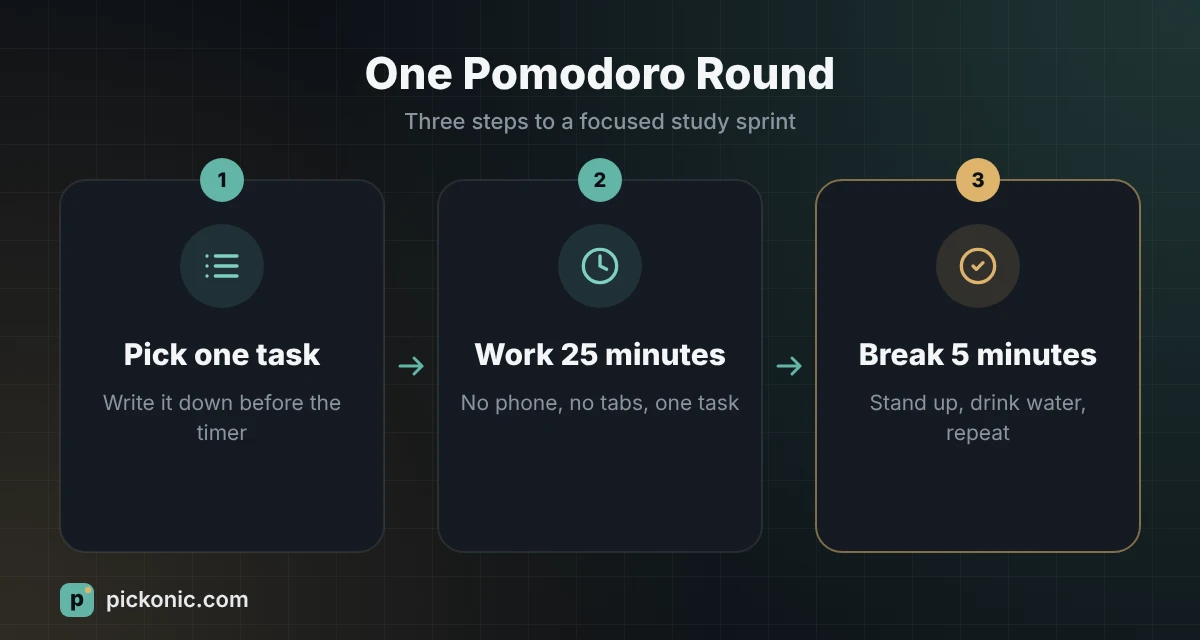
Francesco Cirillo, an Italian university student at the time, developed the method in the late 1980s and named it after the tomato-shaped kitchen timer he used (pomodoro is Italian for tomato). The basic loop, as described on Cirillo’s official Pomodoro site, is:
- Pick one task and set a timer for 25 minutes.
- Work on that task only until the timer rings.
- Take a 5-minute break away from the screen.
- After four rounds, take a longer break of roughly 15 to 30 minutes.
That is the whole method. The value is not in the number 25. It is in three side effects: you commit to one task, you have a visible end to each sprint, and you are forced to pause before you are completely drained.
What the evidence says (and doesn’t)
Be careful with claims like “Pomodoro increases productivity by 40%”. Many websites repeat numbers like that without a source. When you look for solid research, you find less than the internet suggests. A 2025 scoping review in BMC Medical Education searched six databases for studies on the technique, and the authors did not run a meta-analysis because the studies differed too much in design, participants and outcomes. That is a polite way of saying the research is scattered.
What can be said honestly: there is no strong proof that 25 minutes is the best sprint length for everyone, and university learning-support pages that recommend 25/5 mostly do so as practical advice, not as a result of a controlled trial. The method works for many people because breaks and single-task focus are sensible, not because the number 25 is magic. Treat it as a structure to test on yourself for two weeks, not a law.
A realistic evening: what four hours looks like
Take a student with a statistics exam in six days and a chapter on probability to review. A “four-hour” evening on paper looks like this when you apply Pomodoro honestly:
| Block | Time | Task |
|---|---|---|
| Round 1 | 25 min + 5 min break | Read the chapter summary and list the formulas |
| Round 2 | 25 min + 5 min break | Work three solved examples without looking |
| Round 3 | 25 min + 5 min break | Attempt five practice problems |
| Round 4 | 25 min + 20 min long break | Check answers, mark what you got wrong |
| Rounds 5 to 8 | Repeat | Redo the errors, then a new topic |
Notice the arithmetic. Eight rounds is 200 minutes of focused work plus breaks, so about four and a half hours on the clock. Most people who manage four real focused rounds in an evening, around 100 minutes, have done a solid session. If you keep a time budget for the semester, plan in focused minutes, not clock hours.
Where it goes wrong
The break eats the next sprint
A 5-minute break that starts on your phone becomes 25 minutes. Use breaks for things with a natural end: stand up, drink water, stretch, look out of a window. If you do scroll, set the timer first.
The task is too vague
“Study chemistry” is not a task. “Do the practice questions 1 to 10 on acid-base equilibrium” is. A vague task makes the first five minutes of each sprint a negotiation with yourself. Write the next three sprints on paper before you start.
You stop mid-flow
If you are deep into a hard problem when the timer rings, you can extend once. Some people call this “taking the overflow”. The catch is to still take a break afterward, otherwise the method quietly turns into one long session again.
It does not suit every task
Writing an essay introduction, solving a long proof or coding a project often needs more than 25 minutes to warm up. For these, try 40 to 50 minute sprints with a 10-minute break. Nobody official owns the rule; adjust it. The thing you should keep is the timer and the single task.
Adjusting it for common student situations
Short attention span or ADHD
Shorter sprints of 10 to 15 minutes with a physical reward afterward can work better than 25. If attention difficulties are affecting your studies significantly, this is not medical advice: talk to a doctor or your university’s disability or counselling service about proper support.
Studying with a noisy family home
In a shared household in the Gulf, where guests and children are part of normal life, a timer can double as a signal. Tell the others, “I am unavailable until 9:25”. People respect a clear end time more than a closed door.
Online classes and recorded lectures
Do not run a Pomodoro on top of a lecture video and expect the same result. Watch for one sprint, pause, write a summary in your own words for the next sprint. Passive watching with a timer is still passive.
Exam week
Close to exams, the last two rounds of every evening should be recall without notes. Writing what you remember on blank paper and then checking is harder than rereading and tends to show your real gaps, which is the point.
Tools: you do not need an app
A phone timer works, but a phone is also a distraction machine. A cheap kitchen timer or a browser timer on your laptop is better. If you use your phone, switch on do-not-disturb and place it face down across the room. Some universities also publish their own short guides, such as the University of Auckland’s one-page Pomodoro guide, which also suggests 50/10 sprints if 25 minutes feels too short.
If your studying also involves choosing a laptop for note-taking, our student laptop buying guide covers what you actually need.
Connect study time to grades
Time management matters because grades depend on how you divide your effort. A course with more credit hours deserves more of your focused rounds, and a course where you are near a grade boundary may repay extra work more than one where you are already comfortable. To see how a final mark affects your average, use the GPA calculator and read how to calculate cumulative GPA and what counts as a good GPA. Example, purely hypothetical: if a 4-credit course is at 82% and you are two points away from the next grade band, two extra focused rounds a day for a week may be worth more than polishing a 3-credit course already at 95%.
A two-week test you can run
- Days 1 to 7: use 25/5 for every evening session. Count completed rounds in a notebook.
- Days 8 to 14: change one thing, for example 40/10, or phone in another room.
- Compare: how many pages or problems did you finish per evening, and how tired were you afterward?
Keep whichever version gives you more finished work with less dread. That answer is more reliable for you than any article, including this one.
Frequently asked questions
Is 25 minutes the right length for everyone?
No. It is the traditional length and a reasonable starting point. Shorter sprints suit beginners or tired days, and longer ones suit deep work. Test and adjust.
How many Pomodoros should I do per day?
There is no official target. Many students find 6 to 10 genuinely focused rounds a lot for one day. Quality matters more than the count.
Can I use Pomodoro for group study?
Yes, if the group agrees on one task per sprint and breaks are for chatting. Otherwise the chat leaks into the work.
What if I get interrupted during a Pomodoro?
Write the interruption on a sheet of paper to deal with later and carry on. If it is truly urgent, stop the round and start a fresh one afterward instead of counting a half round.