
Your manager says you are getting a raise, and the new figure looks bigger than the old one. That is all most people check. The more useful question is: how big is it, as a percentage, and what is it really worth once prices and the rest of your package are taken into account? Those two answers decide whether you say “thank you” or start preparing for the next conversation.
This guide shows the one formula you need, how to read a raise the way HR reads it, and how to turn the numbers into a clear, specific request.
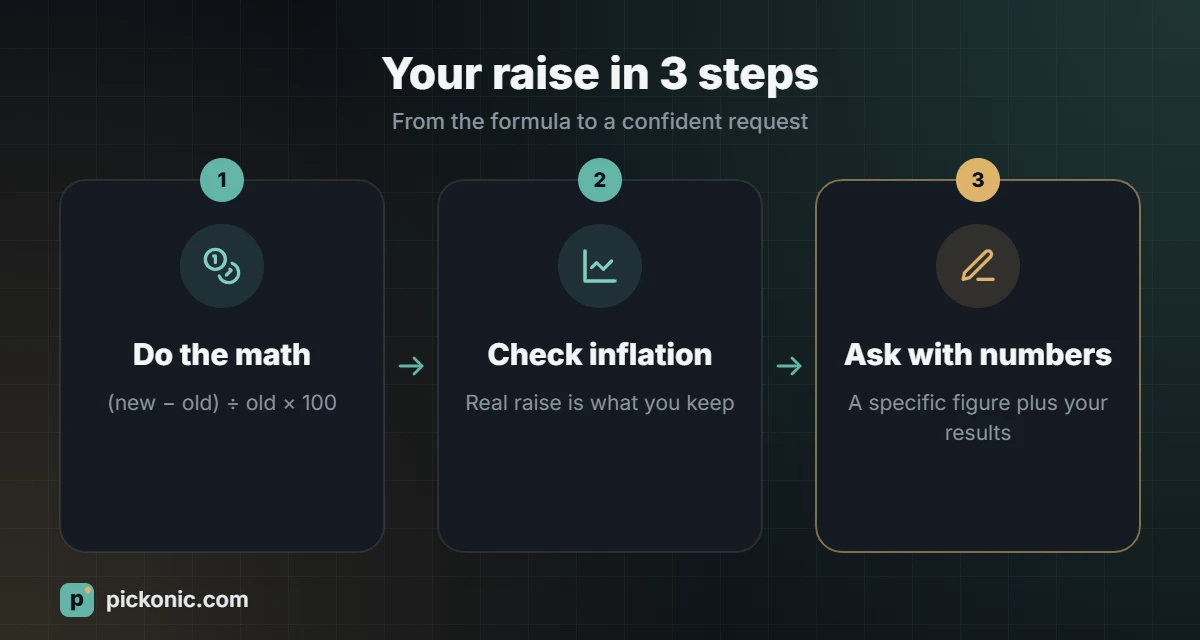
The salary increase formula
Take the new salary, subtract the old one, divide by the old salary and multiply by 100:
Raise % = (new salary − old salary) ÷ old salary × 100
If your monthly salary goes from 12,000 to 12,600, the difference is 600. Divide 600 by 12,000 and you get 0.05, which is a 5% increase.
Always divide by the old salary. Dividing by the new one gives 4.76% in the same example, and that small mistake is how people end up arguing about different numbers in the same meeting.
Working backwards from a target
Sometimes you know the percentage you want and need the figure. Multiply the current salary by 1 plus the percentage as a decimal. A 7% raise on 12,000 is 12,000 × 1.07 = 12,840. Walking into a review with “12,840” is more convincing than “around seven percent”, because it shows you have already done the math.
Basic salary, allowances and the total package
In the Gulf, a monthly salary is usually split into a basic salary and allowances such as housing and transport. A raise can land in either part, and the difference matters more than it looks.
- Basic salary is the base for several calculations. In the UAE, for example, end-of-service gratuity is calculated on the basic wage, not the full package. Our UAE gratuity guide walks through the numbers.
- Allowances raise your take-home pay just as well, but usually leave your gratuity untouched.
- One-off bonuses are not a raise at all. They do not carry into next year’s salary.
So when you compare offers or reviews, calculate the percentage on the basic salary and on the total package separately. A 10% rise in the housing allowance can be a smaller long-term gain than a 4% rise in basic pay.
Nominal raise vs real raise
A raise only makes you better off if it grows faster than prices. The number on your payslip is the nominal raise. What it buys after inflation is the real raise.
The quick version is to subtract the inflation rate from your raise. The precise version is:
Real raise = (1 + raise) ÷ (1 + inflation) − 1
Say you get 5% and inflation over the same year is 3%. The quick estimate is 2%; the exact figure is 1.05 ÷ 1.03 − 1 = 1.94%. For small numbers the shortcut is close enough. The point is the habit: a 3% raise in a year when your rent, school fees and groceries went up 4% is a pay cut in disguise.
| Old salary | New salary | Raise | If prices rose 3% |
|---|---|---|---|
| 10,000 | 10,300 | 3.0% | ≈ 0% |
| 10,000 | 10,500 | 5.0% | ≈ 1.9% |
| 10,000 | 11,000 | 10.0% | ≈ 6.8% |
| 10,000 | 12,000 | 20.0% | ≈ 16.5% |
The inflation figure here is only an example. Use your country’s official consumer price index, or better, your own costs: if most of your money goes on rent and rent jumped, your personal inflation is higher than the headline number.
Is your raise normal?
It helps to know what employers are planning. In Korn Ferry’s 2026 pulse survey reported by Khaleej Times, UAE companies said they were budgeting average base salary increases of 3.4% for 2026, with a median of 3.6%.
Read those figures as a budget across a whole company, not a promise to each person. Strong performers, people in hard-to-fill roles and anyone taking on a bigger job usually sit above the average; others get less or nothing. If your raise is well below the company’s budget and your results were good, that is a fair point to raise.
Promotions are a separate conversation. A new title with more responsibility is the moment to ask for a larger step, and it is easier to negotiate the number before you accept the role than after.
How to ask for a raise with numbers
- Know your current figures. Basic, allowances, total, and what your last raise was in percent.
- Check the market. Look at salary surveys for your field and country, and at real job ads for similar roles. Note ranges, not single numbers.
- List results, not duties. “Cut report preparation from three days to one”, “closed four new accounts”, “trained two new hires”. Numbers make your case easy to forward to whoever approves the budget.
- Ask for a specific figure. Calculate it in advance, for example “a basic salary of 12,840, which is 7%”. A clear number anchors the discussion.
- Have a fallback. If the budget is fixed, ask about moving part of the package into basic salary, a review date in six months, training, or extra leave.
Common mistakes with percentages
- Percent vs percentage points. Going from a 3% raise last year to a 5% raise this year is 2 percentage points more, not 2% more.
- Raises compound. Two years of 5% is 10.25% in total, not 10%, because the second raise applies to the already higher salary.
- Cuts and raises are not symmetrical. A 10% cut followed by a 10% raise leaves you 1% below where you started.
- Mixing monthly and yearly numbers. Keep both figures on the same basis before you divide.
If you want to check any of these quickly, the percentage calculator has a “percentage change” mode that does the division for you. For the general method behind it, see how to calculate a percentage increase.
This article is general information, not financial or legal advice. Salary rules and benefits depend on your contract and your country’s labour law.
Frequently asked questions
Is a 3% raise good?
It is close to the average many UAE employers budgeted for 2026, so it is ordinary rather than generous. Whether it is good for you depends on inflation where you live and on how your performance compares with your team’s.
How do I calculate a raise if I’m paid hourly?
Use the same formula with the hourly rate: (new rate − old rate) ÷ old rate × 100. As long as your hours stay the same, the percentage is identical for weekly, monthly and yearly pay.
Does an increase in allowances count toward gratuity?
In the UAE, gratuity is based on basic salary, so an allowance increase usually does not change it. Check your contract and the official rules for your country before relying on this.
How much should I ask for when I change jobs?
Job moves often come with bigger jumps than annual reviews. Base your number on market ranges for the new role rather than a percentage on top of your current pay, which may itself be below market.