
Cashback or air miles? It is the first question anyone asks when choosing a credit card, and the honest answer is that it depends less on the card and more on how you spend. A card that pays 5% on groceries is worthless if you shop at a supermarket it does not cover, and a travel card full of miles costs you money if you fly once a year. This guide shows you how to work out which type actually pays you more, using your own numbers.
How rewards cards make money (and why it matters to you)
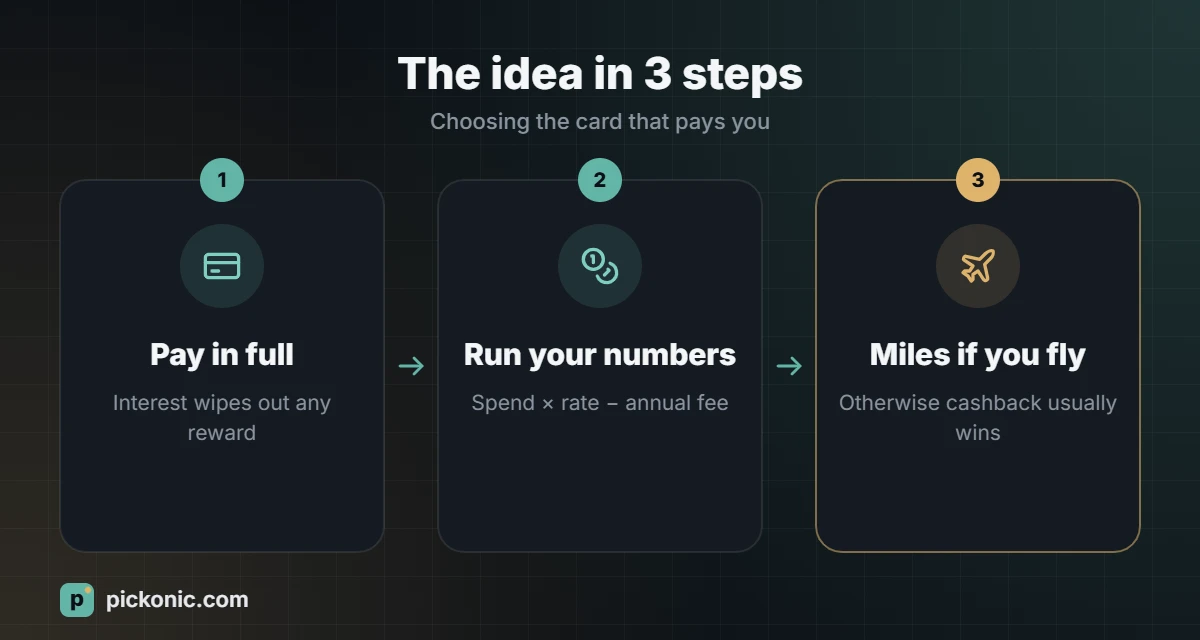
Banks fund rewards from three sources: the fee the merchant pays on each transaction, the card’s annual fee, and the interest charged when customers do not pay their balance in full. That last one is the important part. Interest on credit cards is high; in the UAE, monthly rates of around 3% are common, which works out to more than 35% a year. If you carry a balance even occasionally, the interest will wipe out any reward you earn. Rewards cards only make sense if you pay the full statement balance every month.
Cashback cards: simple and predictable
A cashback card returns a percentage of what you spend, either as a statement credit or as money to your account. They usually come in two styles:
- Flat rate: the same percentage on everything. Easy to understand, nothing to track.
- Tiered or category-based: higher rates on certain categories (groceries, fuel, dining, utilities) and a low rate elsewhere. Often with a monthly cap on how much cashback you can earn.
Cashback suits people whose spending is mostly local and everyday: groceries, fuel, school fees, bills and online shopping.
Travel and miles cards: high value, more rules
Travel cards give points or airline miles per unit spent, often with extras such as airport lounge access, travel insurance or hotel discounts. The value of a mile is not fixed. It depends on how you redeem it: a business-class upgrade on a long flight usually gives far more value per mile than using the same miles for shopping vouchers. Travel cards also tend to have higher annual fees and higher minimum salary requirements.
They suit people who fly several times a year, spend heavily on the card, and are willing to learn the redemption rules of one airline or hotel program.
Compare them with your own numbers
Do this calculation before you apply for anything.
- Add up your typical monthly card spending by category from your last three statements.
- For a cashback card, multiply each category by its rate, apply any monthly cap, and multiply by 12.
- For a travel card, multiply your spending by the miles rate, then multiply by a realistic value per mile based on how you would actually redeem them.
- Subtract each card’s annual fee (unless it is waived for your spending level).
- Add the value of benefits you would genuinely use, like lounge access you would otherwise pay for. Ignore benefits you will not use.
Example: you spend 6,000 a month: 2,000 on groceries, 1,000 on fuel, 1,500 on dining and 1,500 on everything else. A card paying 5% on groceries and fuel (capped at 200 a month) and 1% elsewhere earns 150 + 30 = 180 a month, or 2,160 a year. If its annual fee is 300, the net value is 1,860. Now run the same spending through the travel card you are considering and compare the final figures. The percentage calculator on Pickonic makes these quick.
What to check before applying
| Item | Why it matters |
|---|---|
| Annual fee and waiver conditions | A fee waived only above a spending level you will not reach is not a free card |
| Earning caps | A high rate with a low monthly cap may earn less than a flat-rate card |
| Excluded categories | Government payments, utilities, school fees and wallet top-ups are often excluded or earn less |
| Foreign transaction fee | Usually a few percent on purchases in other currencies; it can cancel out rewards when you travel |
| Expiry of points or miles | Unused points that expire are a hidden loss |
| Minimum salary and documents | Applying for cards you do not qualify for can lead to rejections |
| Interest rate and cash advance fees | Matters if you ever miss a full payment; avoid cash withdrawals on credit cards |
Ask the bank for the card’s Key Facts Statement before you sign. It lists fees, rates and conditions in one place.
Which one should you choose?
- Choose cashback if your spending is mostly local, you want simplicity, or you are getting your first credit card.
- Choose a travel card if you fly often, spend a lot through the card, and will take the time to redeem miles well.
- Use both only if you are organised: one card for categories where it earns most, the other for the rest. More cards mean more fees and more statements to track.
Habits that protect you
- Set up an automatic payment for the full statement balance.
- Keep your total usage well below your limit; high usage can affect your credit score.
- Do not spend more just to earn rewards. 5% back on something you did not need is a 95% loss.
- Review the card once a year. If your spending changed, the best card for you may have changed too.
Rewards only make sense if you clear the balance each month. If you carry debt instead, the loan calculator shows how much a balance really costs you over a year or more.
Frequently asked questions
Is cashback taxable?
For personal spending, cashback is generally treated as a discount on purchases rather than income in most countries, but rules differ, so check local guidance if you are unsure.
Does applying for a card affect my credit score?
Each application usually leads to a credit check. Several applications in a short time can look risky to lenders, so compare first and apply for one card.
Are miles worth it if I only fly once a year?
Usually not. After the annual fee, a good cashback card tends to give more value to occasional travellers.
This article is general information, not financial advice. Compare current offers directly with banks before you apply.