
Buying a car on finance in the UAE usually comes down to one number on the dealer’s screen: the monthly installment. It is worth understanding how that number is built, because the same car can cost thousands more depending on the rate type, the term and the down payment.
The building blocks
- Car price and your down payment. Banks in the UAE typically expect a down payment, often around 20% of the price, although offers vary.
- Finance amount: price minus down payment.
- Rate: often quoted as a flat rate for car loans.
- Term: commonly up to five years.
Worked example with a flat rate
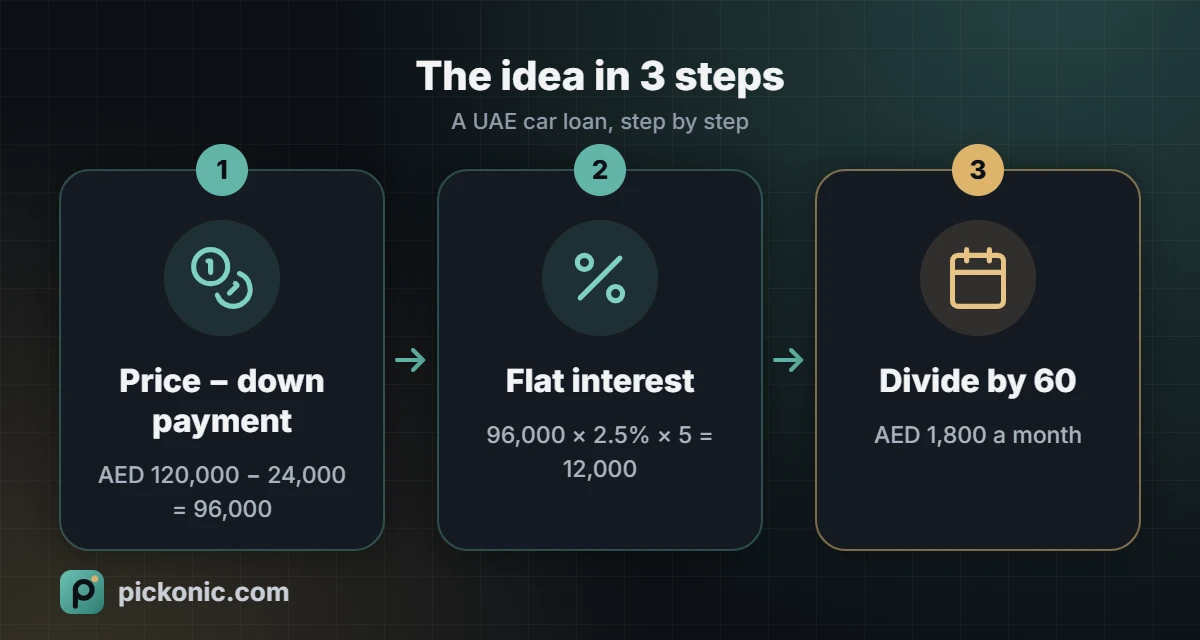
A car costs AED 120,000. You pay 20% down (AED 24,000) and finance AED 96,000 at 2.5% flat for 5 years.
- Interest: 96,000 × 2.5% × 5 = AED 12,000
- Total to repay: 96,000 + 12,000 = AED 108,000
- Monthly installment: 108,000 ÷ 60 = AED 1,800
A 2.5% flat rate over five years works out at roughly 4.7% on a reducing-balance basis. That equivalent rate, the APR, is the fairer number to compare against other offers.
How the term changes the cost
| Term (AED 96,000 at 2.5% flat) | Monthly | Total interest |
|---|---|---|
| 3 years | 2,866.67 | 7,200 |
| 4 years | 2,200.00 | 9,600 |
| 5 years | 1,800.00 | 12,000 |
A longer term lowers the monthly payment but raises the total interest. If the shorter term fits comfortably in your budget, it usually saves money.
Costs the installment does not show
- Processing or arrangement fees.
- Comprehensive insurance, which lenders normally require for the full term.
- Registration and any dealer add-ons rolled into the loan.
- Early settlement charges if you want to pay off the loan sooner.
A quick affordability check
Many people use a simple rule of thumb: keep all monthly debt payments well within your income so that a surprise expense does not become a crisis. UAE regulations also cap how much of your salary can go to debt repayments, and your bank will check this when you apply.
This article is for general information and is not financial advice. Rates and rules change, so confirm the details with your lender.
The full formula for a reducing-balance loan
Most bank car loans in the UAE quote a flat rate, but it helps to know the standard formula for a reducing-balance loan so you can compare offers:
EMI = P × r × (1 + r)^n ÷ ((1 + r)^n − 1)
where P is the loan amount, r is the monthly interest rate (annual rate ÷ 12) and n is the number of months. For 80,000 at 5% a year over 60 months, r = 0.004167 and the EMI comes to about 1,510 a month, with total interest of roughly 10,580.
The same loan at a 3% flat rate costs 80,000 × 3% × 5 = 12,000 in interest, an EMI of about 1,533. The flat rate looks lower but costs more, which is why it is worth asking every lender for the reducing-balance equivalent or the APR. Our flat vs reducing rate guide explains the difference in detail.
Down payment: how much difference does it make?
For a car priced at 100,000, compare a 20% and a 30% down payment at a 3% flat rate over five years:
| Down payment | Loan amount | Total interest | Monthly EMI |
|---|---|---|---|
| 20,000 (20%) | 80,000 | 12,000 | ≈ 1,533 |
| 30,000 (30%) | 70,000 | 10,500 | ≈ 1,342 |
Putting an extra 10,000 down saves 1,500 in interest and lowers the monthly payment by about 190. If that cash would otherwise sit in a current account earning nothing, a bigger down payment is usually the better use of it, as long as you keep an emergency fund.
Before you sign
- Ask for the total amount payable over the whole loan, not just the EMI.
- Ask for the APR or reducing-balance equivalent rate.
- Check early settlement fees and how unearned interest is treated if you pay off early.
- Find out whether insurance must be bought through the bank and what it costs each year.
- Read the rules on salary transfer and what happens if you change jobs.
Lending rules for banks are set by the Central Bank of the UAE, and your bank must give you a key facts statement with the costs before you commit.
Frequently asked questions
Is a shorter loan always better?
It costs less interest overall but has a higher monthly payment. Choose the shortest term whose EMI still leaves room for savings and emergencies.
Does the EMI include insurance?
Usually not. Car insurance is a separate yearly cost, and some banks also add life insurance linked to the loan.
Can I reduce the EMI after taking the loan?
Only by refinancing or by making a partial early payment if the bank allows it. Both can carry fees, so ask for the numbers in writing first.
This article is general information, not financial advice.