
Body mass index is probably the most widely used health number in the world. Doctors check it, insurers ask for it and fitness apps show it on day one. It is also easy to misread. A single number cannot describe a whole body, and BMI was never designed to.
Where BMI comes from
The formula was devised in the 1830s by the Belgian mathematician Adolphe Quetelet, who was studying the “average man” across large populations. It was renamed body mass index in the 1970s and later adopted by the World Health Organization as a simple way to screen populations for weight-related risk.
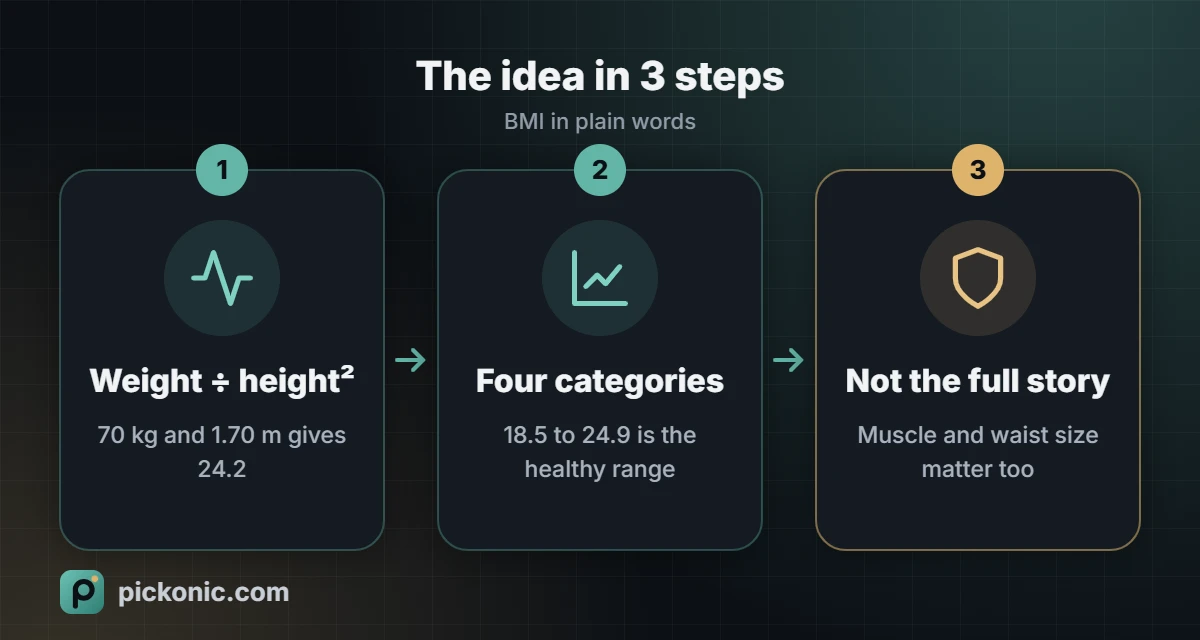
A person who weighs 82 kg and is 1.78 m tall has a BMI of 82 ÷ (1.78 × 1.78) = 25.9.
The adult categories
| BMI | Category |
|---|---|
| Under 18.5 | Underweight |
| 18.5 to 24.9 | Healthy weight |
| 25 to 29.9 | Overweight |
| 30 and over | Obesity |
These bands come from large studies linking BMI to health outcomes such as type 2 diabetes and heart disease. On average, risk rises as BMI moves away from the healthy range in either direction.
Where BMI falls short
It cannot see muscle
Muscle is denser than fat. A strong, lean athlete can register as “overweight” while carrying very little fat.
It ignores where fat sits
Fat stored around the abdomen is linked to higher health risk than fat on the hips or thighs. Two people with the same BMI can have very different risk profiles. That is why many doctors also measure waist size.
One size does not fit all
A WHO expert consultation noted that health risks can begin at lower BMI values in many Asian populations, which is why some countries use lower thresholds. Age, sex and ethnicity all affect how much body fat sits behind a given BMI.
So is BMI useful?
Yes, as a starting point. It is free, takes seconds and is a reasonable screening tool for most adults. Just treat it as one clue rather than a verdict. If your BMI is outside the healthy range, or you are worried about your weight, a conversation with a doctor will give you a far better picture than any single number.
How to calculate BMI by hand
BMI is your weight in kilograms divided by your height in metres squared. For someone who weighs 78 kg and is 1.76 m tall: 1.76 × 1.76 = 3.10, and 78 ÷ 3.10 = 25.2, which sits just inside the “overweight” band.
If you use pounds and inches, multiply by 703: BMI = weight (lb) × 703 ÷ height (in)². A person who is 170 lb and 5 ft 9 in (69 in) has a BMI of 170 × 703 ÷ 4,761 ≈ 25.1.
Turning BMI into a healthy weight range
You can also run the formula backwards to see which weights fall in the 18.5–24.9 range for your height. Multiply each limit by your height squared. At 1.76 m: 18.5 × 3.10 ≈ 57 kg and 24.9 × 3.10 ≈ 77 kg. So for that height the “normal” BMI range covers roughly 57 to 77 kg.
That 20 kg spread is a useful reminder that there is no single ideal weight. Where you sit inside the range depends on frame, muscle and what feels sustainable for you.
Waist measurements: the useful second number
Because BMI cannot tell where fat is stored, many doctors pair it with a waist measurement. Fat carried around the abdomen is more closely linked to heart disease and type 2 diabetes than fat elsewhere.
- Waist-to-height ratio: a simple rule of thumb is to keep your waist measurement below half your height. At 176 cm, that means a waist under 88 cm.
- How to measure: stand straight, breathe out normally and measure halfway between the bottom of your ribs and the top of your hip bone.
BMI for children and teenagers
The adult cut-offs do not apply under 20. Children are assessed with BMI-for-age percentiles that account for growth, using charts published by the World Health Organization and national health bodies. A paediatrician is the right person to interpret them.
Frequently asked questions
Is a BMI of 25 bad?
It sits on the border between normal and overweight. On its own it is not a diagnosis; waist size, fitness, blood pressure and blood tests tell a fuller story.
Why do some countries use lower cut-offs?
Research shows some populations, including many people of South Asian and East Asian descent, face higher health risks at lower BMI values, so some health bodies use lower action points for them.
How often should I check my BMI?
Weight changes daily with water and food. Weighing once a week at the same time of day gives a clearer trend than checking every morning.
This article is general information, not medical advice. Talk to a doctor about your own health.
What does BMI mean?
BMI stands for body mass index: your weight in kilograms divided by your height in metres squared. For adults, the WHO groups the result into underweight (below 18.5), healthy weight (18.5 to 24.9), overweight (25 to 29.9) and obesity (30 and above). It is a screening number, not a diagnosis.