
Picture two car finance offers on your desk. The dealer advertises 2.99%. Your bank quotes 5.25%. Most people would sign with the dealer on the spot. Put both offers through a calculator, though, and the 2.99% deal turns out to be the more expensive one.
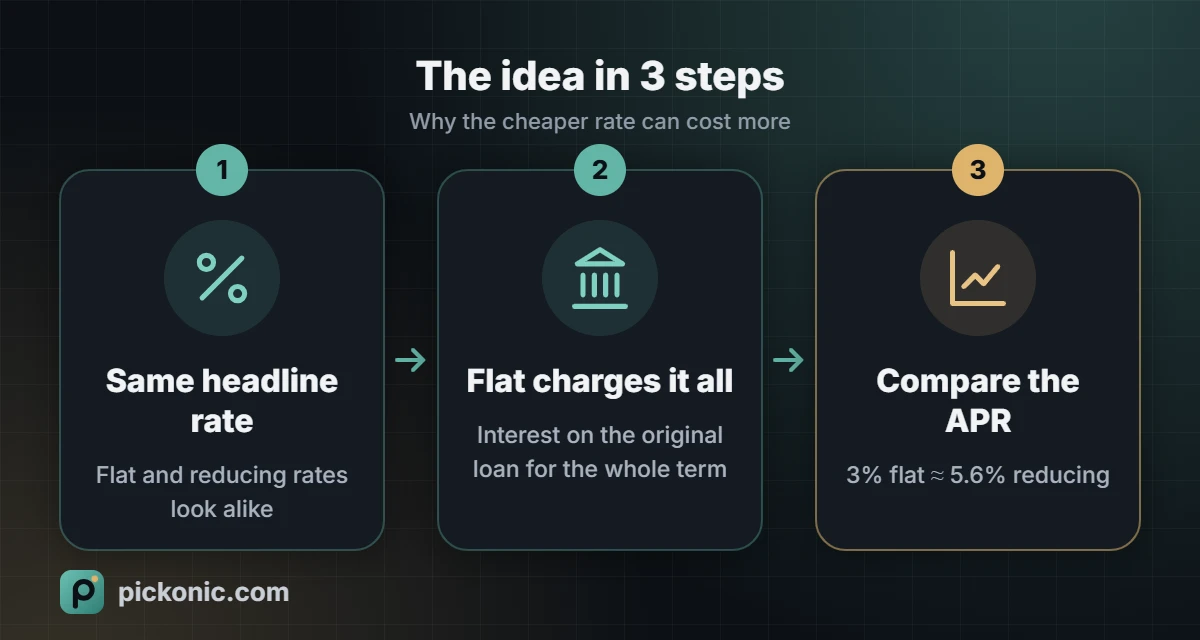
The reason is the difference between flat-rate and reducing-balance interest. It is one of the most expensive misunderstandings in personal finance, and it is common across the Gulf, especially for car loans.
How reducing-balance interest works
With a reducing-balance loan, interest is charged on what you still owe. In month one you owe the full amount, so the interest portion is large. Each payment cuts the balance, so next month’s interest is a little smaller, and more of your payment goes to the principal. Mortgages and most personal loans work this way.
How flat-rate interest works
With a flat rate, interest is calculated once on the original amount, for the whole term, and spread evenly across the payments. Borrow 100,000 at 3% flat for five years and the interest is 100,000 × 3% × 5 = 15,000, no matter how much you have already repaid.
Here is the catch. Halfway through that loan you only owe about half the money, but you are still paying interest as if you owed all of it. On average you owe roughly half the amount over the life of the loan, so a flat rate costs close to double what the same reducing rate would.
The numbers side by side
| Loan: 100,000 over 5 years | Monthly payment | Total interest |
|---|---|---|
| 3% flat | 1,916.67 | 15,000 |
| 5% reducing | 1,887.12 | 13,227 |
| 5.64% reducing | 1,916.67 | 15,000 |
The last row is the key. A 3% flat loan behaves exactly like a 5.64% reducing loan. That 5.64% is its equivalent annual percentage rate (APR), and it is the number you should compare.
A quick way to estimate
For typical car loan terms of three to five years, multiply the flat rate by about 1.8 to 1.9 to get a rough APR. A 3% flat rate is around 5.5% to 5.7% APR. Our loan calculator works out the exact figure for you.
Questions to ask before you sign
- Is this rate flat or reducing? If the salesperson is not sure, assume flat.
- What is the APR? Lenders in many countries must disclose it, and it is the fair comparison number.
- What fees are added? Processing fees, insurance and registration all raise the real cost.
- What does early settlement cost? With a flat loan, settling early may not save you as much interest as you expect.
The bottom line
A headline rate on its own tells you almost nothing. Convert every offer to the same basis, compare total interest and total cost, and the right choice usually becomes obvious.
The reducing-balance formula, step by step
For a reducing-balance loan the monthly payment is:
Payment = P × r × (1 + r)^n ÷ ((1 + r)^n − 1)
P is the amount borrowed, r is the monthly rate (annual rate ÷ 12) and n is the number of monthly payments. For 100,000 at 5% over 5 years: r = 0.05 ÷ 12 = 0.004167 and n = 60, which gives a payment of about 1,887 a month and total interest of about 13,227.
The same 100,000 at a 3% flat rate costs 100,000 × 3% × 5 = 15,000 in interest, or 1,917 a month. So “3%” costs about 1,800 more than “5%” here.
Flat rates and their reducing equivalents
Approximate equivalents for a 5-year loan with monthly payments:
| Flat rate | Approximate reducing-balance rate |
|---|---|
| 2.0% | ≈ 3.8% |
| 3.0% | ≈ 5.6% |
| 4.0% | ≈ 7.4% |
| 5.0% | ≈ 9.2% |
The longer the loan, the bigger the gap, because a flat rate keeps charging interest on money you have already repaid. Treat these as estimates and ask the lender for the exact APR.
Early settlement: where the difference really shows
With a reducing-balance loan, paying early cuts future interest immediately, because interest is only charged on what you still owe. With flat-rate loans, the saving from settling early depends on how the lender calculates the interest it has not yet earned, and there may be a settlement fee. If there is any chance you will pay the loan off early, for example after a bonus or the sale of the car, compare the settlement terms as carefully as the rate.
A checklist for comparing two offers
- Total amount payable over the full term.
- APR or reducing-balance equivalent.
- Processing and arrangement fees.
- Required insurance and its yearly cost.
- Early settlement and partial payment terms.
- Conditions such as salary transfer or minimum income.
Frequently asked questions
Is a flat rate always worse?
Not automatically. It is a different way of quoting the price. Converted to an equivalent rate, a flat-rate offer can still be the cheapest; you just have to compare like with like.
Why do banks quote flat rates?
They are simple to calculate and to advertise. Consumer protection rules in many countries require lenders to also disclose the effective rate or total cost, so ask for it.
Can I use the loan calculator for both types?
Yes. Pickonic’s loan calculator shows flat and reducing-balance results side by side so you can see the real difference.
This article is general information, not financial advice.
What is the difference between a flat rate and APR?
A flat rate charges interest on the original loan amount for the whole term, even as you pay it down. APR, or a reducing rate, charges interest only on what you still owe. That is why a flat rate looks lower on paper: a 5% flat rate over five years works out to roughly 9% as a reducing rate. The loan calculator shows the equivalent for your own term.