
You see a protein shake advert promising “120 g a day for real results”, your cousin eats chicken at every meal, and your doctor once mentioned that kidneys don’t like too much. So how much do you actually need? For most healthy adults the honest answer is less than the supplement aisle suggests, and the number depends on a few things you can work out yourself in two minutes.
This article gives you the baseline, shows when it goes up, and turns it into a daily target in grams. It is general nutrition information, not medical advice. If you have kidney disease, are pregnant, are managing diabetes or an eating disorder, or are unsure, see a doctor or a registered dietitian before changing your diet.
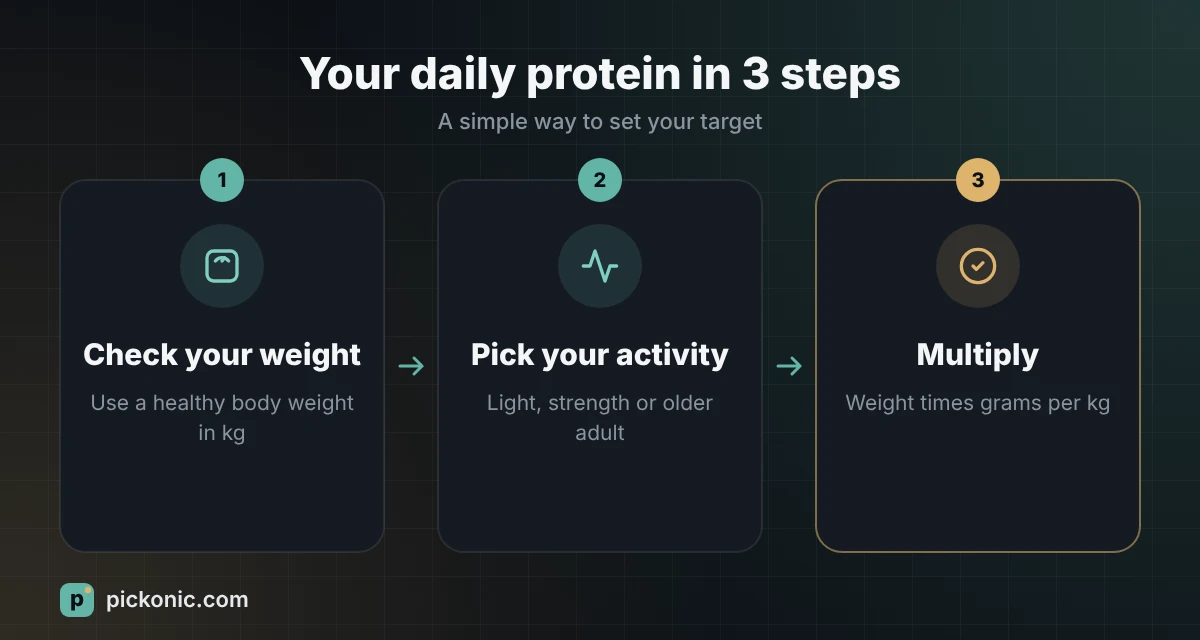
The baseline: 0.8 grams per kilogram
The figure most often used for healthy adults comes from the US and Canadian Dietary Reference Intakes: a Recommended Dietary Allowance of 0.8 g of protein per kilogram of body weight per day, built on an estimated average requirement of 0.66 g/kg (as summarised in this open-access review in PubMed Central). The allowance is set high enough to cover almost all healthy people, so it already includes a safety margin. The NHS guidance on protein is a good place to read about protein sources as part of a balanced diet.
The calculation is a single multiplication:
- 60 kg adult: 60 × 0.8 = 48 g per day
- 70 kg adult: 70 × 0.8 = 56 g per day
- 85 kg adult: 85 × 0.8 = 68 g per day
Use a realistic, healthy body weight, not a dream weight. If you are well above a healthy weight, ask a dietitian whether to base the figure on your actual weight or a target weight.
When you need more than the baseline
The 0.8 figure is a floor for healthy adults with ordinary activity. Some groups are usually advised to aim higher:
| Group | Typical range (g per kg per day) | 70 kg example |
|---|---|---|
| Healthy adult, light activity | 0.8 | 56 g |
| Older adults (reviews often cite 1.2 to 1.5) | 1.0 to 1.5 | 70 to 105 g |
| Endurance athletes | 1.2 to 1.4 | 84 to 98 g |
| Strength and power training | 1.2 to 1.7 | 84 to 119 g |
The athlete and older-adult ranges come from review articles and sports nutrition summaries, and sources differ slightly, so treat them as ranges rather than rules. Older adults often get higher advice because muscle responds less efficiently to protein with age. If you are 65 or over and losing strength, a dietitian can tailor this.
What about weight loss?
When you eat fewer calories, a little more protein can help you keep muscle and feel full, which is why people dieting often aim for the upper part of the ranges above. This is a reason to plan your meals, not a reason to cut food drastically. Our guide to how many dates a day shows how to count calories and sugar from a food you probably eat every day.
Protein as a share of calories
Some guidelines express protein as a percentage of energy: adults are commonly advised to get roughly 10 to 35 percent of their calories from protein. Protein provides about 4 kcal per gram, so the conversion is easy. On a 2,000 kcal day, 15 percent is 300 kcal, which is 75 g. Our percentage calculator does this kind of conversion in a second, and it helps you see whether a 2,400 kcal day with 20 percent protein (120 g) is more than you intended.
If your target from the per-kilogram method and your target from the percentage method disagree, that is normal. Choose the per-kilogram number for planning and use the percentage as a sanity check.
Turning grams into food
Protein targets are only useful if you can picture the plate. Approximate values per 100 g, from nutrition databases that cite USDA data, are: cooked skinless chicken breast roughly 25 to 30 g, plain Greek yogurt around 10 g, and cooked lentils around 9 g. Figures vary with cut, brand and cooking, so read the label on the pack you actually buy.
A practical way to reach 70 g without a shake is to build each meal around one protein source and spread the load: some at breakfast, a palm-sized portion at lunch and dinner, and a protein snack if you need one. Spreading it out beats loading one huge dinner, and most people already get a lot of protein incidentally from bread, rice, dairy and nuts.
A sample day, as a rough illustration
These are hypothetical portions using the approximate values above, not a meal plan. Say you weigh 70 kg and aim for about 75 g. A 200 g pot of plain Greek yogurt at breakfast gives around 20 g. A 150 g portion of cooked chicken breast at lunch gives roughly 38 to 45 g. A 200 g bowl of cooked lentils at dinner adds around 18 g. That is about 76 to 83 g before counting bread, rice, milk or nuts, which would push you higher. In other words, many people overshoot the baseline without trying, and the useful question is whether the rest of the plate has vegetables and fibre too.
What to look for on a label
Packaged foods list protein per 100 g and often per serving. Compare per 100 g when choosing between products, then check the serving size to see what you will actually eat. Protein bars and “high protein” snacks often carry added sugar or saturated fat, so read the rest of the label before assuming they are the better choice.
Common mistakes
- Copying a gym number. A 120 g target makes sense for a heavy lifter, not for a 55 kg office worker walking twice a week.
- Counting weight of food instead of protein in it. 100 g of chicken is not 100 g of protein.
- Forgetting plant protein. Lentils, chickpeas, beans, tofu and whole grains add up and bring fibre with them.
- Drinking shakes on top of a diet that already meets the target. Extra protein is not stored as muscle by itself; training does that.
- Ignoring hydration. Our post on how much water to drink covers that part.
When this does not apply
People with chronic kidney disease are often given an individual, sometimes lower, protein target. Children, teenagers, pregnant and breastfeeding women have different needs from the adult baseline. And if you take a medicine or follow a medically supervised diet, your clinician’s figure beats any online formula, including this one.
To combine your protein target with your body measurements, start with your BMI, which gives you a quick idea of where your weight sits before you pick a number.
Frequently asked questions
How much protein do I need if I don’t exercise?
About 0.8 g per kilogram of body weight for a healthy adult, so roughly 48 to 68 g for most people between 60 and 85 kg.
Is too much protein harmful?
For healthy people, moderate increases within the ranges above are generally considered fine, but very high intakes have little proven benefit and are not advised if you have kidney problems. Ask your doctor if unsure.
Do I need a protein shake?
No, food can meet the target. A shake is a convenience for people who struggle to reach it, not a requirement.
Can I get enough protein as a vegetarian?
Yes, with dairy, eggs, legumes, tofu, nuts and grains across the day. Plan a source at each meal, and a dietitian can help if you eat very little variety.
Should I use my weight or my ideal weight?
For people at a healthy weight, use actual weight. If you are well above or below it, ask a dietitian which number to use.