
You have probably heard that you should drink eight glasses of water a day, and you have probably also been told it is a myth. Both statements are half true, which is why the question never goes away. If you live in a place where July afternoons hit 45°C, the stakes feel higher: you want to know whether the bottle on your desk is enough, or whether you are quietly drifting into a headache.
This article gives you a number you can actually use, shows where it comes from, and explains when to ignore it. It is general information, not medical advice. If you have kidney, heart or liver disease, or a doctor has set a fluid limit for you, follow that advice instead of anything written here.
Where the “eight glasses” rule comes from
There is no single trial behind it. The idea circulates as “6 to 8 glasses of fluid a day”, and the NHS guidance on water and drinks still uses that range as a practical target. Note the word fluid. Water counts, but so do lower-fat milk, tea, coffee and other sugar-free drinks.
A glass is not a fixed unit either. With a 200 ml glass, six to eight glasses is 1.2 to 1.6 litres. With a 250 ml glass, it is 1.5 to 2 litres. That is a reasonable starting point for a sedentary day in a mild climate, not a law of physiology.
What the larger reference numbers say
The European Food Safety Authority sets an adequate intake for total water of about 2.5 litres a day for men and 2.0 litres for women, in its 2010 scientific opinion on dietary reference values for water. “Total” is the key word. It includes the water in food, which typically supplies roughly a fifth to a quarter of the amount. Soup, fruit, vegetables, yoghurt and rice all carry water.
So the two figures are not in conflict. If about 20 to 30 percent of 2.0 to 2.5 litres comes from food, you are left with roughly 1.5 to 2 litres to drink, which matches the NHS range.
| Source | What it measures | Figure |
|---|---|---|
| NHS | Fluids you drink | 6 to 8 glasses |
| EFSA | Total water, food and drink, women | about 2.0 L |
| EFSA | Total water, food and drink, men | about 2.5 L |
These are averages for healthy adults in a temperate climate. They are a starting point, and the next sections explain why your own number moves.
Why your number is different from your colleague’s
A large 2022 study in Science, which measured water turnover in thousands of people across many countries, found that the amount of water people take in and lose varies widely. Age, body size, physical activity, and the temperature and humidity where you live all mattered. You can read the paper by Yamada and colleagues or the university summary of it. The practical lesson is that two healthy adults of the same weight can need noticeably different amounts, and nobody can set your target from a chart alone.
Heat and sweat
If you spend your commute walking from a car park to an office in a Gulf summer, or you work on a site, you lose more fluid than someone in an air-conditioned room all day. Sweat is mostly water plus salts. Replacing only the water after hours of heavy sweating is not always ideal, and for long outdoor work it is worth eating normally so you also replace sodium.
Exercise
A gym session or a football match at night raises the need on that day. A sensible habit is to drink a glass beforehand, sip during, and drink again afterward. For a casual 45-minute workout, plain water is enough.
Pregnancy, breastfeeding and illness
Needs go up in pregnancy and breastfeeding, and when you have a fever, vomiting or diarrhoea. These are situations to talk through with a doctor or midwife rather than with a generic rule.
A better test than counting glasses
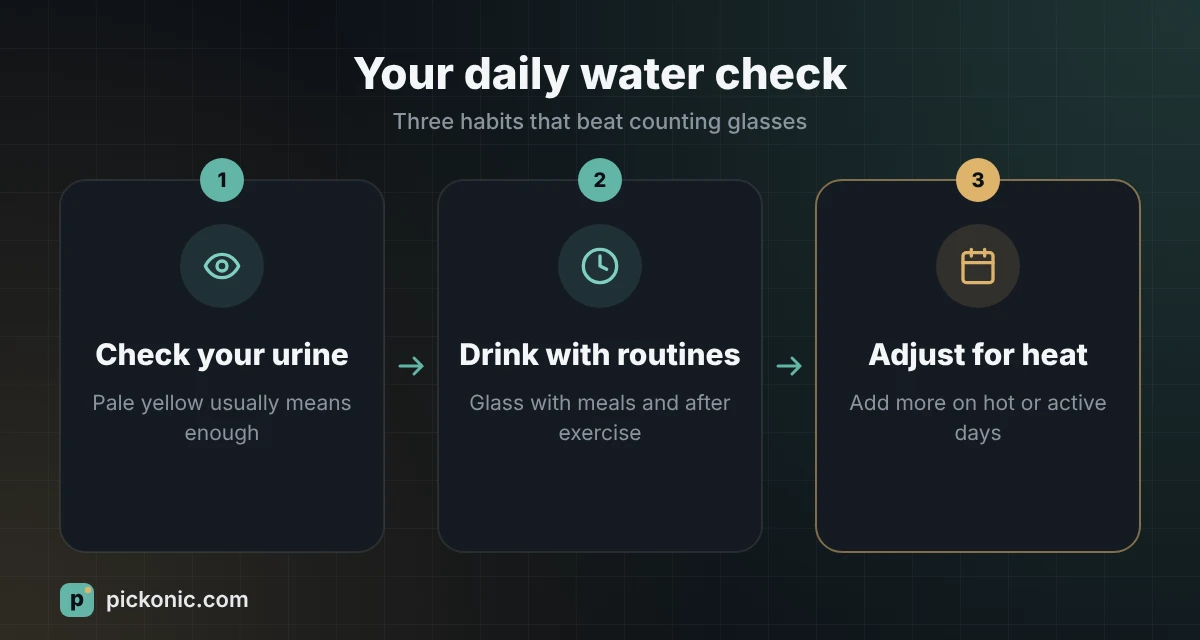
For most healthy adults, thirst is a reliable signal, and urine colour is a useful cross-check. Pale yellow, like straw, usually means you are fine. Dark amber, strong smell and going many hours without urinating suggest you should drink more. Clear as water, many times an hour, can mean you are overdoing it.
Two caveats. Some vitamin supplements, notably B vitamins, turn urine bright yellow whatever your hydration. And some medicines change urine colour. If the colour is odd and persistent, that is a question for a pharmacist or doctor, not a hydration problem.
A realistic day, as a worked example
This is a hypothetical day for a 30-year-old office worker in Dubai, using 250 ml glasses. It is an illustration, not a prescription.
- Glass of water after waking: 250 ml
- Coffee or tea at breakfast: 200 ml
- Water at the desk through the morning, two glasses: 500 ml
- Water with lunch: 250 ml
- Afternoon tea or karak: 200 ml
- Water during the afternoon, one glass: 250 ml
- Water with dinner: 250 ml
- Evening: one more glass: 250 ml
That adds up to about 2.15 litres of drinks, before the water in lunch and dinner. It is comfortable, and it never requires you to force down a litre in one go. On a day when you walk outdoors in the heat or train in the evening, you would add a few glasses and watch the urine colour.
If you are curious how body size relates to these numbers, our BMI explainer covers what a body mass index does and does not tell you. Note that a bigger body does not mean you must follow a formula such as “35 ml per kilo”. Such formulas are popular online, but they are rules of thumb rather than an established standard.
What counts, and what to watch
Water is the default. Tea and coffee count toward your fluid, despite the old claim that they dehydrate you. In the amounts most people drink, they do not cancel out the fluid they contain, though caffeine-heavy energy drinks bring other problems.
Sugary drinks are where people go wrong. Fruit juice and smoothies contain free sugars. UK public health advice caps them at a combined 150 ml a day, and the same guidance suggests taking them with meals to protect teeth. Soft drinks and sweetened coffee drinks can add a lot of sugar without making you feel full.
Can you drink too much?
Yes, though it is uncommon. Drinking very large volumes in a short time, for example several litres in an hour as a challenge, can dilute the sodium in the blood, a condition called hyponatraemia. It is a real risk for endurance athletes who drink far more than they sweat, and it is a reason not to chase a huge target. Spread your drinking across the day and stop when you are no longer thirsty.
When this advice does not apply
- You have heart failure, kidney disease, liver cirrhosis or a condition that requires a fluid restriction. Follow the number your doctor gave you.
- You take diuretics or other medicines that change fluid balance. Ask your pharmacist.
- You are an elite or endurance athlete with a structured hydration plan.
- You are fasting. During Ramadan all your drinking has to fit between iftar and suhoor, so plan the glasses in advance. Religious rulings about fasting and exemptions differ in details, so check with the official body in your country.
Warning signs of heat illness, such as confusion, a very high body temperature, fainting or hot, dry skin, are an emergency. Do not try to fix them with a glass of water. Call emergency services.
Simple habits that make it work
Put a bottle where you work and refill it twice. Drink a glass with every meal. Keep water in the car, since Gulf summers can punish a short breakdown. Flavour it with lemon or mint if plain water bores you. Skip the “drink two litres at once” tricks, which mostly send you to the bathroom.
This is general information, not medical advice. See a doctor if you are unusually thirsty for weeks, pass much more urine than normal, or feel dizzy often, since these can be signs of an underlying condition.
Frequently asked questions
Is 2 litres of water a day the right target?
It is a sensible round number for many adults, and it sits inside the range implied by the NHS and EFSA figures. Treat it as a starting point and adjust for heat, exercise and how you feel.
Do tea and coffee count?
Yes. The NHS lists tea and coffee among the drinks that count toward your fluid. Watch the sugar and the late-evening caffeine if it affects your sleep.
Does thirst mean I am already dehydrated?
Not usually. Thirst is the body’s normal prompt for healthy adults. Older people can have a weaker thirst signal, so for them a routine of regular drinks is wiser.
Can I count the water in food?
EFSA’s total-water figures include food, which typically provides about a fifth to a quarter of intake. If you are counting only drinks, aim lower than the total figure.
Is drinking more water a good way to lose weight?
Water in place of sugary drinks helps, because you cut calories. Beyond that, extra water on its own is not a weight-loss method.