
If you have lived in the Gulf for a few years, you will have noticed Ramadan creeping backwards through the calendar: a summer Ramadan becomes a spring Ramadan, then a winter one. The reason is simple once you see it, and it says a lot about how calendars work.
A calendar that follows the moon
The Gregorian calendar is solar. It tracks the Earth’s orbit around the Sun, which takes about 365.24 days, and keeps the seasons in place by adding a leap day every four years.
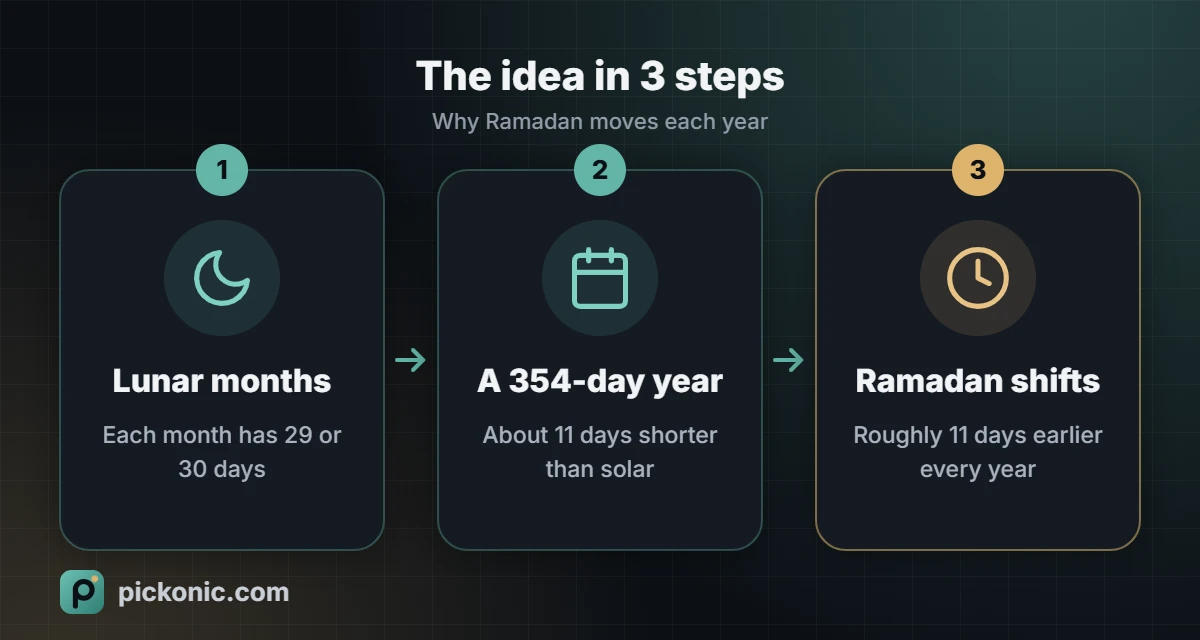
The Hijri calendar is lunar. Each month begins with the new crescent moon, and a lunar month lasts about 29.53 days. Twelve of them add up to roughly 354 days. There is no leap month to realign with the Sun, so the Hijri year is about 11 days shorter than the Gregorian year.
Those 11 days are the whole story. Every Hijri date, including the first of Ramadan, Eid al-Fitr and Eid al-Adha, lands about 11 days earlier in the Gregorian calendar each year. It takes around 33 years for Ramadan to travel all the way around the seasons and return.
Where does the calendar start?
Year 1 of the Hijri calendar begins with the Hijra, the Prophet Muhammad’s migration from Mecca to Medina in 622 CE. That is why Hijri years are written with “AH”, from the Latin Anno Hegirae.
Moon sighting vs Umm al-Qura
Traditionally a new month starts when the crescent is seen after sunset. Because sighting depends on weather and location, two countries can start a month on different days.
For civil and administrative purposes, Saudi Arabia uses the Umm al-Qura calendar, which is based on astronomical calculation rather than sighting. Dates are known years in advance, which is essential for contracts, government services and documents. Religious occasions are still often confirmed by sighting, which is why Ramadan can occasionally begin a day before or after the Umm al-Qura date.
Why the 29th and 30th matter
A Hijri month always has either 29 or 30 days. There is no 31st. This catches people out when converting dates: “30 Safar” only exists in years when Safar has 30 days. A good converter will tell you when a date does not exist rather than quietly shifting it.
Converting dates reliably
Because month lengths vary, there is no simple formula that gives the exact date every time. Rough estimates are fine for history homework, but for anything official you need a converter that uses the Umm al-Qura tables.
The twelve Hijri months
| # | Month | Notes |
|---|---|---|
| 1 | Muharram | First month of the year; one of the four sacred months |
| 2 | Safar | |
| 3 | Rabi al-Awwal | |
| 4 | Rabi al-Thani | Also called Rabi al-Akhir |
| 5 | Jumada al-Ula | |
| 6 | Jumada al-Akhirah | |
| 7 | Rajab | A sacred month |
| 8 | Sha’ban | The month before Ramadan |
| 9 | Ramadan | The month of fasting |
| 10 | Shawwal | Eid al-Fitr falls on 1 Shawwal |
| 11 | Dhu al-Qa’dah | A sacred month |
| 12 | Dhu al-Hijjah | Hajj season; Eid al-Adha on the 10th; a sacred month |
Each month has 29 or 30 days, depending on the moon. A Hijri year therefore has 354 or 355 days, about 11 days shorter than a Gregorian year.
Why Ramadan moves through the seasons
Because the Hijri year is shorter, every Islamic date arrives about 11 days earlier on the Gregorian calendar each year. Ramadan that starts in early March one year will start in late February the next, and in roughly 33 years it will have passed through every season and returned to the same Gregorian dates. That is why fasting can mean long summer days for some years and shorter winter days for others, depending on where you live.
How the calendar is used today
- Religious dates such as Ramadan, the two Eids and Hajj follow the Hijri calendar everywhere.
- Saudi Arabia uses the Umm al-Qura calendar for official Hijri dates. Since 2016, most government salaries and the fiscal year follow the Gregorian calendar, but Hijri dates still appear on many documents.
- Other countries generally use the Gregorian calendar for civil life and the Hijri calendar for religious occasions, often with announcements based on local moon sighting.
Converting a date by hand (and why you shouldn’t for anything official)
A rough rule converts a Hijri year to a Gregorian one: Gregorian year ≈ Hijri year × 0.97 + 622. For 1448 AH that gives 2026.6, so 1448 runs across 2026 and 2027. The rule is fine for estimating a year, but useless for exact days. For anything official, use a converter based on Umm al-Qura and check the result by converting it back.
To see your own age in both calendars at once, use the age calculator. It shows your Gregorian and Hijri age side by side.
Frequently asked questions
When does the Hijri year start?
On 1 Muharram. Because of the 11-day drift, that falls on a different Gregorian date every year.
Why do countries sometimes start Ramadan on different days?
Some rely on local moon sighting, others on calculation or on the announcement of another country. The difference is usually a single day.
What does AH mean?
Anno Hegirae, “in the year of the Hijra”, marking years from the Prophet’s migration from Makkah to Madinah in 622 CE.