
If you work in the UAE private sector, your end-of-service gratuity is probably the biggest single payment you will receive from your employer. It is also one of the most misunderstood. Colleagues swap numbers in the pantry, old rules from before 2022 still float around, and HR spreadsheets do not always explain themselves.
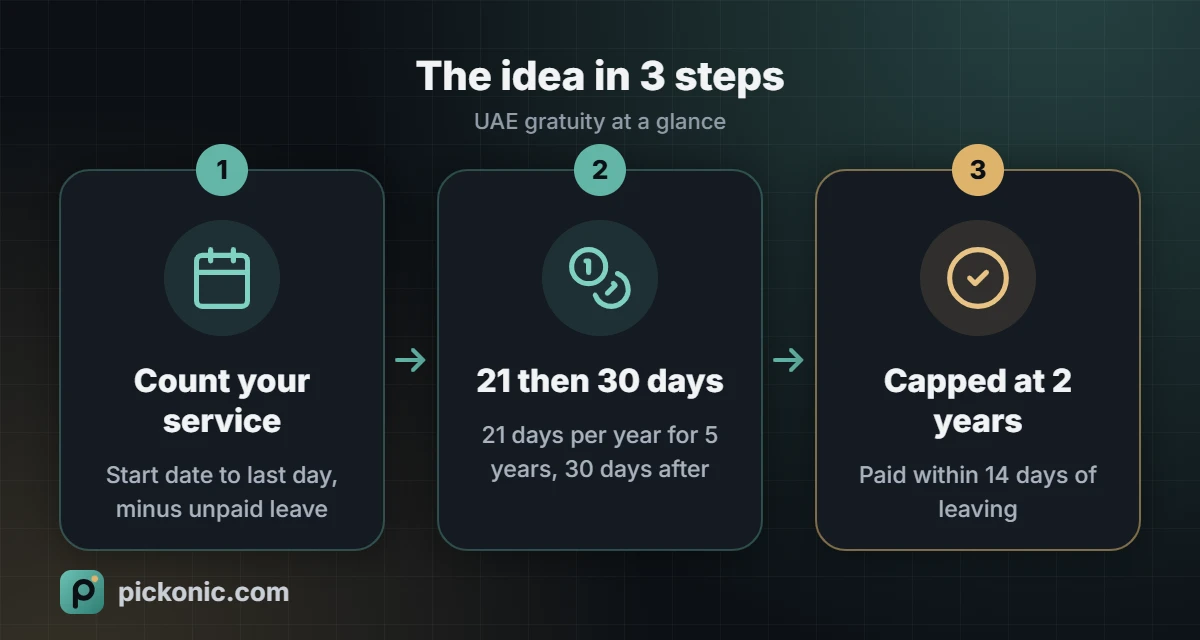
The good news is that the current rules are simple once you see them laid out. This guide walks through them step by step, with real numbers.
Which law applies?
Since 2 February 2022, private sector employment in the UAE is governed by Federal Decree-Law No. 33 of 2021. It replaced the 1980 labour law and changed gratuity in two important ways: resignation no longer cuts your entitlement, and the distinction between limited and unlimited contracts disappeared.
Free zones such as DIFC and ADGM have their own employment laws, and UAE nationals are usually covered by the pension system instead of gratuity. If either applies to you, check your specific rules.
The basic rule
You qualify once you complete at least one year of continuous service. After that, gratuity is based on your last basic salary, not your total package:
- 21 days of basic salary for each of the first five years
- 30 days of basic salary for each year after that
To turn “days” into money, divide your monthly basic salary by 30 to get a daily wage. Most calculators, including ours, use this convention.
A worked example
Sara earns a basic salary of AED 12,000 a month and leaves after 6 years and 6 months.
- Daily wage: 12,000 ÷ 30 = AED 400
- First five years: 21 × 400 × 5 = AED 42,000
- Remaining 1.5 years: 30 × 400 × 1.5 = AED 18,000
- Total gratuity: AED 60,000
Notice that the half year counts. Partial years are paid in proportion, so you do not lose months of service just because you left mid-year.
Things that change the number
Unpaid leave
Days of unpaid absence are not counted as service. If Sara took 30 days of unpaid leave, her service would drop by those days before the calculation is run.
The cap
Total gratuity cannot exceed two years of salary. In practice this only matters for very long careers with the same employer.
Money you owe
The law allows the employer to deduct amounts you legitimately owe them, such as an outstanding loan, from your final settlement.
What about resignation?
Under the old law, resigning early could reduce gratuity to a third or two thirds. That rule is gone. Today, if you resign after one year or more, you receive the same gratuity as someone whose contract ended. You still need to respect your notice period, and leaving before you complete one year means no gratuity at all.
When should you be paid?
Your employer must pay all end-of-service dues, including gratuity, within 14 days of the end of your employment. If that does not happen, you can file a complaint with the Ministry of Human Resources and Emiratisation (MOHRE).
A quick checklist before your last day
- Confirm the basic salary figure in your latest contract or payslip.
- Check your exact start date, including any probation period, which counts as service.
- Ask HR how many unpaid leave days, if any, are on your record.
- Run the numbers yourself so you can spot a mistake before you sign the settlement.
Quick reference table
Using a basic salary of 6,000 AED a month (daily wage 6,000 ÷ 30 = 200 AED):
| Service | Days of basic pay | Gratuity |
|---|---|---|
| 1 year | 21 | 4,200 |
| 3 years | 63 | 12,600 |
| 5 years | 105 | 21,000 |
| 8 years | 105 + 90 = 195 | 39,000 |
| 12 years | 105 + 210 = 315 | 63,000 |
The total is capped at two years’ basic salary, 144,000 AED in this example.
Part years after the first year
Once you complete one year, fractions of a year are paid pro rata. Three years and six months at 6,000 basic comes to 63 days for the full years plus 10.5 days for the half year: 73.5 days × 200 = 14,700 AED.
Frequently asked questions
Do I get gratuity if I resign?
Yes, under the current private-sector law there is no reduction for resignation, provided you have completed at least one year of continuous service.
Is gratuity calculated on basic or gross salary?
On the last basic salary only. Housing, transport and other allowances are not included.
How soon must it be paid?
The employer must pay end-of-service dues within 14 days of the end of employment.
Does this apply in free zones and government jobs?
Not always. Some free zones, such as DIFC, and government entities have their own rules, so check the regulations that apply to your employer.
Official guidance is published by the Ministry of Human Resources and Emiratisation.
This article is general information, not legal advice.